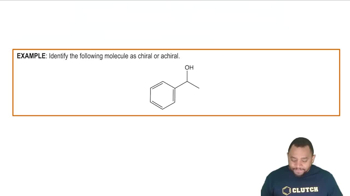
Using the alcohol shown, draw all the possible alkenes that might be formed on its dehydration. Which alkenes can exist as cis–trans isomers? Draw them, in both condensed and line structure, and identify each as cis or trans. Explain your choices.
Identify all chiral centers in the isomers that you drew for part (a).
Verified step by step guidance
Verified video answer for a similar problem:
Key Concepts
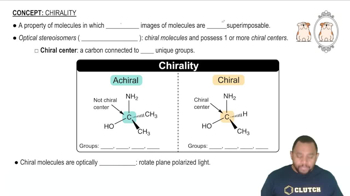
Chirality
Chiral Centers
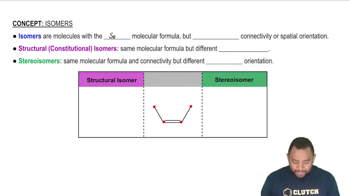
Isomers
Using the alcohol shown, draw all the possible alkenes that might be formed on its dehydration. Which do you think will be the major product(s)? Which do you think will be the minor product(s)? It is alright to have more than one major and minor product.
Draw all possible cyclic C7H14O alcohol isomers having a cyclohexane ring and a methyl group. (Hint: Adapt the method described in Worked Example 12.12 to arrive at your answers.)
'Designer vinegars' have become very popular over the past decade. Vinegars made from champagne, merlot, and other wines are but a few of these. All wines contain ethanol, and these vinegars are simply wines containing microorganisms that have caused oxidation of the ethanol present. If vinegar is simply ethanol that has been oxidized, what is the structure of the acid formed?
Name the following compounds:
e.
f.
