
Textbook Question
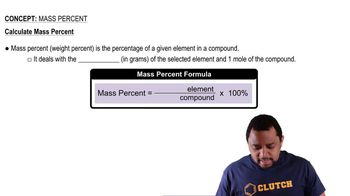
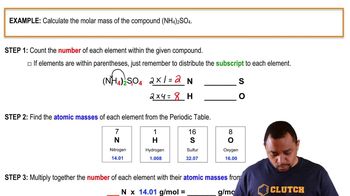
Uric acid, the principal constituent of some kidney stones, has the formula C5H4N4O3. In aqueous solution, the solubility of uric acid is only 0.067 g/L. Express this concentration in (m/v)%, in parts per million, and in molarity.
 Verified step by step guidance
 00:38
00:38
 03:12
03:12 01:30
01:30Uric acid, the principal constituent of some kidney stones, has the formula C5H4N4O3. In aqueous solution, the solubility of uric acid is only 0.067 g/L. Express this concentration in (m/v)%, in parts per million, and in molarity.
How many milliliters of 0.150 M BaCl2 are needed to react completely with 35.0 mL of 0.200 M Na2SO4? How many grams of BaSO4 will be formed?
Ammonia, NH3, is very soluble in water (51.8 g/L at 20 °C and 760 mmHg).
a. Show how NH3 can hydrogen bond to water.
Which of the following solutions will give rise to a greater osmotic pressure at equilibrium: 5.00 g of NaCl in 350.0 mL water or 35.0 g of glucose in 400.0 mL water? For NaCl, MW = 58.5 amu; for glucose, MW = 180 amu.
An isotonic solution must be approximately 0.30 osmol/L. How much KCl is needed to prepare 175 mL of an isotonic solution?
Cobalt(II) chloride, a blue solid, can absorb water from the air to form cobalt(II) chloride hexahydrate, a pink solid. The equilibrium is so sensitive to moisture in the air that CoCl2 is used as a humidity indicator.
a. Write a balanced equation for the equilibrium. Be sure to include water as a reactant to produce the hexahydrate.