
Textbook Question
Why is it not possible to balance an equation by changing the subscript on a substance, say from H2O to H2O2?
3
views
 Verified step by step guidance
 00:58
00:58
 01:16
01:16 2:08
2:08Why is it not possible to balance an equation by changing the subscript on a substance, say from H2O to H2O2?
What is meant by the term 'balanced equation'?
Potassium, a silvery metal, reacts with bromine, a corrosive, reddish liquid, to yield potassium bromide, a white solid. Write the balanced equation, and identify the oxidizing and reducing agents.
Identify the oxidized reactant, the reduced reactant, the oxidizing agent, and the reducing agent in the following reactions:
a. Fe(s) + Cu2+(aq) → Fe2+(aq) + Cu(s)
b. Mg(s) + Cl2(g) → MgCl2(s)
c. 2 Al(s) + Cr2O3(s) → 2 Cr(s) + Al2O3(s)
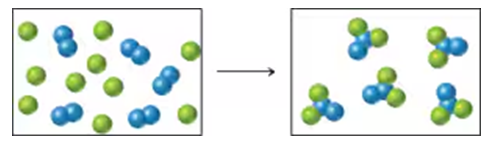
Assume that the mixture of substances in drawing (a) undergoes a reaction. Which of the drawings (b)–(d) represent a product mixture consistent with the law of conservation of mass?
An aqueous solution of a cation (represented as blue spheres in the diagram) is allowed to mix with a solution of an anion (represented as green spheres) and the following result is obtained:
Which combinations of cation and anion, chosen from the following lists, are compatible with the observed results? Explain.
Cations: Na+, Ca2+, Ag+, Ni2+
Anions: Cl−, CO23–, CrO42–, NO3–