If one sweetener packet of Splenda, Sweet’N Low, or Equal has the same sweetness as two tablespoons of sugar, according to Table 6.2, which of the packets contains the smallest amount of the sweetener?
Ch.6 Carbohydrates Life's Sweet Molecules
Frost4th EditionGeneral, Organic and Biological ChemistryISBN: 9780134988696Not the one you use?Change textbook
Chapter 3, Problem 45a
Give the name of one or more polysaccharides that matches each of the following descriptions:
(a) not digestible by humans
Verified step by step guidance1
Understand the term 'polysaccharide': Polysaccharides are large carbohydrate molecules composed of long chains of monosaccharide units bonded together. They serve various functions, such as energy storage and structural support.
Identify polysaccharides that are not digestible by humans: Humans lack the enzymes required to break down certain polysaccharides, making them indigestible. For example, cellulose is a polysaccharide that cannot be digested by humans because we lack the enzyme cellulase.
Explain why cellulose is indigestible: Cellulose is composed of β-glucose units linked by β-1,4-glycosidic bonds. Human digestive enzymes, such as amylase, can only break α-glycosidic bonds, not β-glycosidic bonds.
Consider other examples: Other polysaccharides that are not digestible by humans include chitin, which is found in the exoskeletons of arthropods. Chitin is composed of N-acetylglucosamine units linked by β-glycosidic bonds.
Summarize the answer: Polysaccharides like cellulose and chitin are examples of carbohydrates that are not digestible by humans due to the absence of specific enzymes required to break their β-glycosidic bonds.

Verified video answer for a similar problem:
This video solution was recommended by our tutors as helpful for the problem above.
Video duration:
5mWas this helpful?
Key Concepts
Here are the essential concepts you must grasp in order to answer the question correctly.
Polysaccharides
Polysaccharides are complex carbohydrates composed of long chains of monosaccharide units. They serve various functions in living organisms, including energy storage and structural support. Common examples include starch, glycogen, and cellulose, each differing in their sugar composition and bonding patterns.
Recommended video:
Guided course
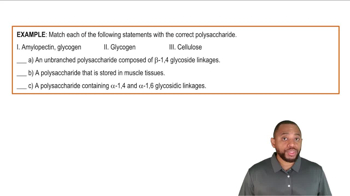
Polysaccharides Example 1
Digestibility
Digestibility refers to the extent to which a substance can be broken down and absorbed by the digestive system. In the context of polysaccharides, some, like starch, are digestible, while others, such as cellulose, are not due to the human body's lack of enzymes to break down certain glycosidic bonds.
Recommended video:
Guided course
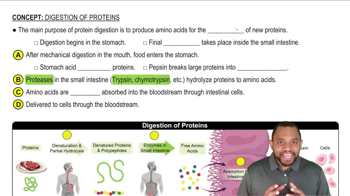
Digestion of Proteins Concept 1
Cellulose
Cellulose is a polysaccharide that forms the primary structural component of plant cell walls. It is composed of β-glucose units linked by β-1,4-glycosidic bonds, making it indigestible for humans. While it cannot be broken down for energy, cellulose plays a crucial role in digestive health as dietary fiber.
Related Practice
Textbook Question
Textbook Question
Based on the sweetness index in Table 6.2, if you tasted a drop of each of the syrups below, which would taste the sweetest?
(a) light corn syrup (100% glucose)
Textbook Question
Give the name of one or more polysaccharides that matches each of the following descriptions:
(d) produces maltose during digestion
1
views
Textbook Question
Explain whether the following blood types could be donated to a person with type B blood:
(a) A
Textbook Question
Describe the similarities and differences of the following polysaccharides:
(a) amylose and amylopectin
Textbook Question
How is the polysaccharide heparin different from the glucose polysaccharides?