
Textbook Question
What type of interactions between an enzyme and its substrate help to stabilize ES?

 Verified step by step guidance
 2:39
2:39
 1:26
1:26 01:37
01:37What type of interactions between an enzyme and its substrate help to stabilize ES?
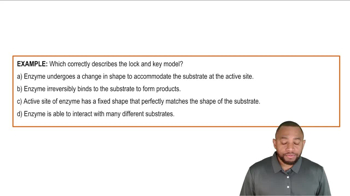
The enzyme trypsin catalyzes the breakdown of many structurally diverse proteins in foods. Does the induced-fit or lock-and-key model explain the action of trypsin better? Explain.
Do the amino acids that are in the active site of an enzyme have to be near each other in the enzyme’s primary structure? If no, explain.
Does each of the following statements describe a simple enzyme (no cofactor or coenzyme necessary), an enzyme that requires a cofactor, or an enzyme that requires a coenzyme?
c. contains vitamin B6 in its active site
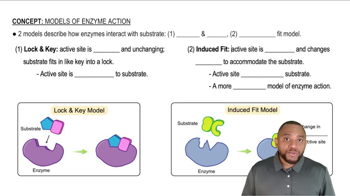
Match the terms (1) active site, (2) lock-and-key model, and (3) induced-fit model with the following descriptions:
a. the portion of an enzyme where catalytic activity occurs
b. the active site adapts to the shape of a substrate
c. the active site has a rigid shape
Does each of the following statements describe a simple enzyme (no cofactor or coenzyme necessary), an enzyme that requires a cofactor, or an enzyme that requires a coenzyme?
b. consists of one polypeptide chain in its active form