Skip to main content
GOB Chemistry
My Course
Learn
Exam Prep
AI Tutor
Study Guides
Textbook Solutions
Flashcards
Explore
Try the app
My Course
Learn
Exam Prep
AI Tutor
Study Guides
Textbook Solutions
Flashcards
Explore
Try the app
Back
Paste flashcard_updated
1 student found this helpful
You can tap to flip the card.
Primary difference between ionic and covalent bonds in electron behavior
You can tap to flip the card.
👆
Primary difference between ionic and covalent bonds in electron behavior
Ionic bonds involve the transfer of electrons from one atom to another, while covalent bonds involve the sharing of electrons between atoms.
Track progress
Control buttons has been changed to "navigation" mode.
1/5
Recommended videos
Guided course
01:06
Ionic Bonding Example 2
3
views
Guided course
01:16
Ionic Bonding Example 1
14
views
1
rank
Guided course
02:33
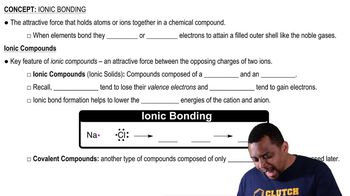
Ionic Bonding Concept 1
5
views
1
rank
Terms in this set (5)
Hide definitions
Primary difference between ionic and covalent bonds in electron behavior
Ionic bonds involve the transfer of electrons from one atom to another, while covalent bonds involve the sharing of electrons between atoms.
Why do noble gases rarely form chemical bonds?
Noble gases have a full valence electron shell, making them chemically stable and unlikely to form bonds.
Mass number of an element with 11 protons and 12 neutrons
The mass number is 23, calculated as protons (11) plus neutrons (12).
Balanced chemical equation for hydrogen and oxygen forming water
The balanced equation is \(2H_2 + O_2 \rightarrow 2H_2O\).
pH indication of a substance with pH 2
A pH of 2 indicates the substance is an acid.
 BackBack
 01:06
01:06