Back

Types of RNA quiz

Control buttons has been changed to "navigation" mode.
1/15
  • How does RNA differ from DNA in terms of structure?

    RNA is generally shorter and single-stranded, while DNA is longer and double-stranded.
  • What are the three main types of RNA?

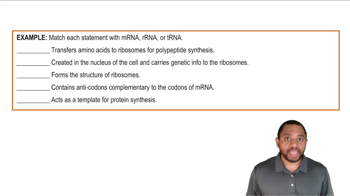
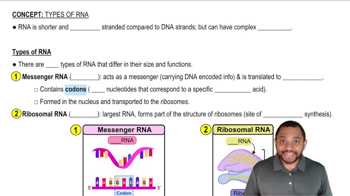
    The three main types of RNA are messenger RNA (mRNA), ribosomal RNA (rRNA), and transfer RNA (tRNA).
  • What is the primary function of mRNA?

    mRNA acts as a messenger, carrying DNA-encoded information to the protein synthesis machinery.
  • Where is mRNA formed and where does it go after formation?

    mRNA is formed in the nucleus and then transported to the ribosomes for protein synthesis.
  • What are codons and what do they specify?

    Codons are sequences of three nucleotides in mRNA that specify a particular amino acid.
  • What is the largest type of RNA and what is its role?

    Ribosomal RNA (rRNA) is the largest type of RNA and forms part of the ribosome's structure, playing a crucial role in protein synthesis.
  • What organelle is the site of protein synthesis?

    The ribosome is the organelle where protein synthesis occurs.
  • What is the smallest type of RNA and what does it do?

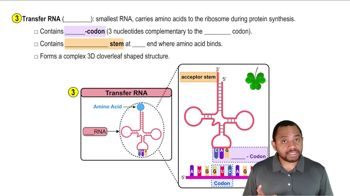
    Transfer RNA (tRNA) is the smallest type of RNA and carries amino acids to the ribosome during protein synthesis.
  • What is an anticodon and where is it found?

    An anticodon is a sequence of three nucleotides in tRNA that is complementary to the mRNA codon.
  • How does tRNA ensure correct amino acid placement during protein synthesis?

    tRNA uses its anticodon to match with the complementary mRNA codon, ensuring the correct amino acid is added.
  • What is the acceptor stem in tRNA and where is it located?

    The acceptor stem is at the 3' end of tRNA and is the site where amino acids bind.
  • Describe the shape of tRNA.

    tRNA has a complex 3D cloverleaf-shaped structure.
  • What nucleotide does RNA use instead of thymine?

    RNA uses uracil instead of thymine.
  • How are codons and anticodons related?

    Codons in mRNA are matched by complementary anticodons in tRNA during protein synthesis.
  • Why is RNA generally shorter than DNA?

    RNA is shorter because it only copies a small portion of DNA's genetic information for specific functions.