Back

Types of Chemical Reactions definitions

Control buttons has been changed to "navigation" mode.
1/15
  • Chemical Reaction

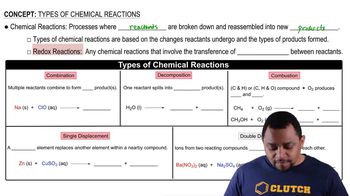
    Process where reactants are broken down and reassembled into new products, classified by changes and products formed.
  • Reactant

    Substance present at the start of a process, undergoing change to form new substances.
  • Product

    New substance formed as a result of a process involving rearrangement of atoms.
  • Redox Reaction

    Process involving the transfer of electrons between substances, altering their oxidation states.
  • Combination Reaction

    Process where multiple substances merge to yield a single new substance.
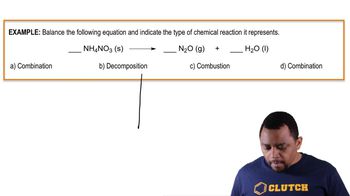
  • Decomposition Reaction

    Process where a single substance splits into two or more simpler substances.
  • Combustion Reaction

    Process where compounds containing carbon and hydrogen react with oxygen to yield water and carbon dioxide.
  • Single Displacement Reaction

    Process where one element replaces another within a compound, forming a new element and compound.
  • Double Displacement Reaction

    Process where ions from two compounds exchange places, forming two new compounds.
  • Electron Transfer

    Movement of negatively charged particles from one substance to another, central to redox processes.
  • Ionic Compound

    Substance formed from the electrostatic attraction between oppositely charged ions, often involved in displacement.
  • Oxidation State

    Numerical value representing the hypothetical charge an atom would have after electron transfer.
  • Sulfate

    Polyatomic ion composed of sulfur and oxygen, commonly involved in displacement reactions.
  • Nitrate

    Polyatomic ion containing nitrogen and oxygen, often exchanged in double displacement processes.
  • Hydrogen Gas

    Diatomic molecule produced during decomposition of water, characterized by its flammability.