Skip to main content
GOB Chemistry
My Course
Learn
Exam Prep
AI Tutor
Study Guides
Textbook Solutions
Flashcards
Explore
Try the app
My Course
Learn
Exam Prep
AI Tutor
Study Guides
Textbook Solutions
Flashcards
Explore
Try the app
Back
Total Energy from Fatty Acids quiz
You can tap to flip the card.
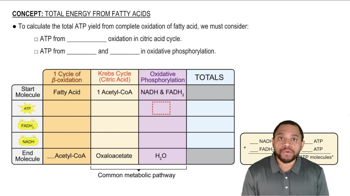
What are the two main processes to consider when calculating total ATP yield from fatty acid oxidation?
You can tap to flip the card.
👆
What are the two main processes to consider when calculating total ATP yield from fatty acid oxidation?
You must consider ATP from acetyl CoA oxidation in the citric acid cycle and ATP from NADH and FADH2 in oxidative phosphorylation.
Track progress
Control buttons has been changed to "navigation" mode.
1/15
Related flashcards
Related practice
Recommended videos
Total Energy from Fatty Acids definitions
Total Energy from Fatty Acids
12 Terms
Total Energy from Fatty Acids
24. Lipid Metabolism
4 problems
Topic
Laura
Ketone Bodies
24. Lipid Metabolism
3 problems
Topic
Laura
24. Lipid Metabolism - Part 1 of 2
8 topics
15 problems
Chapter
KeyshawnDavis
24. Lipid Metabolism - Part 2 of 2
1 topic
3 problems
Chapter
Nicole
Guided course
3:08
Total Energy from Fatty Acids Concept 1
3
views
Guided course
4:19
Total Energy from Fatty Acids Example 1
7
views
Terms in this set (15)
Hide definitions
What are the two main processes to consider when calculating total ATP yield from fatty acid oxidation?
You must consider ATP from acetyl CoA oxidation in the citric acid cycle and ATP from NADH and FADH2 in oxidative phosphorylation.
How many ATP are required for fatty acid activation?
Fatty acid activation requires a one-time expense of 2 ATP.
What does each cycle of beta oxidation produce?
Each cycle produces 1 FADH2, 1 NADH, and 1 acetyl CoA.
How many ATP, FADH2, and NADH are generated from one acetyl CoA in the citric acid cycle?
One acetyl CoA generates 1 ATP, 1 FADH2, and 3 NADH in the citric acid cycle.
What is the role of NADH and FADH2 in oxidative phosphorylation?
NADH and FADH2 transfer electrons to oxygen, forming water and generating ATP.
How many ATP are produced from 4 NADH during oxidative phosphorylation?
4 NADH produce a total of 10 ATP (2.5 ATP per NADH).
How many ATP are produced from 2 FADH2 during oxidative phosphorylation?
2 FADH2 produce a total of 3 ATP (1.5 ATP per FADH2).
What is the total ATP yield before subtracting the activation cost?
The total ATP yield is 13 ATP before subtracting the 2 ATP used for activation.
What is the net ATP gain from the complete oxidation of a fatty acid after accounting for activation?
The net gain is 12 ATP after subtracting the 2 ATP used for activation.
Why are the ATP, FADH2, and NADH numbers for fatty acid oxidation different from glucose oxidation?
Fatty acid oxidation numbers are for one acetyl CoA, while glucose oxidation typically involves two acetyl CoA, doubling the amounts.
What is the final electron acceptor in oxidative phosphorylation?
Oxygen is the final electron acceptor, which is reduced to water.
What are the common metabolic pathways mentioned in the context of fatty acid oxidation?
The citric acid cycle and oxidative phosphorylation are the common metabolic pathways.
How many NADH are produced in total from one cycle of beta oxidation and the citric acid cycle?
A total of 4 NADH are produced: 1 from beta oxidation and 3 from the citric acid cycle.
How many FADH2 are produced in total from one cycle of beta oxidation and the citric acid cycle?
A total of 2 FADH2 are produced: 1 from beta oxidation and 1 from the citric acid cycle.
What is the significance of subtracting the 2 ATP used for fatty acid activation?
Subtracting the 2 ATP accounts for the energy cost required to activate the fatty acid before oxidation can proceed.
 BackBack
 3:08
3:08