Skip to main content
GOB Chemistry
My Course
Learn
Exam Prep
AI Tutor
Study Guides
Textbook Solutions
Flashcards
Explore
Try the app
My Course
Learn
Exam Prep
AI Tutor
Study Guides
Textbook Solutions
Flashcards
Explore
Try the app
Back
The Ideal Gas Law definitions
You can tap to flip the card.
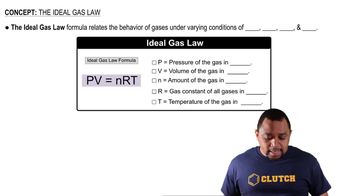
Ideal Gas Law
You can tap to flip the card.
👆
Ideal Gas Law
A mathematical relationship connecting pressure, volume, moles, and temperature for gases under ideal conditions.
Track progress
Control buttons has been changed to "navigation" mode.
1/13
Related flashcards
Related practice
Recommended videos
The Ideal Gas Law quiz
The Ideal Gas Law
15 Terms
The Ideal Gas Law
8. Gases, Liquids and Solids
4 problems
Topic
Jules
The Ideal Gas Law Derivations
8. Gases, Liquids and Solids
3 problems
Topic
Jules
8. Gases, Liquids and Solids - Part 1 of 2
8 topics
15 problems
Chapter
Jules
8. Gases, Liquids and Solids - Part 2 of 2
7 topics
15 problems
Chapter
Jules
Guided course
02:58
The Ideal Gas Law Example 1
50
views
3
rank
Guided course
01:15
The Ideal Gas Law Concept 1
73
views
2
rank
Guided course
01:56
The Ideal Gas Law Concept 2
35
views
2
rank
Terms in this set (13)
Hide definitions
Ideal Gas Law
A mathematical relationship connecting pressure, volume, moles, and temperature for gases under ideal conditions.
Pressure
A measure of force exerted by gas particles against the walls of a container, typically expressed in atmospheres.
Volume
The amount of three-dimensional space occupied by a gas, commonly measured in liters.
Moles
A unit representing the quantity of gas particles, used to relate the amount of substance in chemical calculations.
Gas Constant
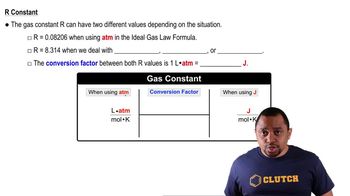
A proportionality factor, symbolized as R, with values depending on the context of the calculation.
Kelvin
The absolute temperature scale used in gas law calculations, ensuring all values are positive.
Atmosphere
A standard unit for measuring pressure, often used in gas law equations.
Joule
A unit of energy, used when converting between different forms of the gas constant.
Liters
A metric unit for measuring the volume of gases in ideal gas law problems.
Conversion Factor
A numerical value used to change units, such as from liters times atmospheres to joules.
Energy
A property calculated using the gas constant value of 8.314, relevant in kinetic and thermodynamic contexts.
Speed
A physical quantity related to the motion of gas particles, requiring a specific value of the gas constant.
Velocity
A vector quantity describing the rate and direction of gas particle movement, linked to energy calculations.
 BackBack
 02:58
02:58