Back

The Citric Acid Cycle quiz

Control buttons has been changed to "navigation" mode.
1/15
  • What two molecules combine to form citrate in the first step of the Citric Acid Cycle?

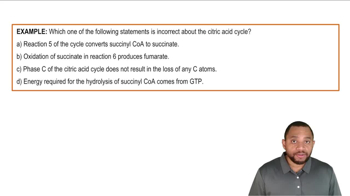
    Acetyl CoA and oxaloacetate combine to form citrate, catalyzed by citrate synthase.
  • Which enzyme catalyzes the isomerization of citrate to isocitrate in the Citric Acid Cycle?

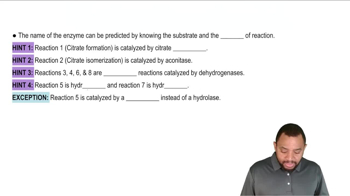
    Aconitase catalyzes the isomerization of citrate to isocitrate.
  • What is produced during the oxidation and decarboxylation of isocitrate to alpha-ketoglutarate?

    One NADH and one CO2 are produced during this reaction, catalyzed by isocitrate dehydrogenase.
  • Which enzyme is responsible for converting alpha-ketoglutarate to succinyl CoA?

    Alpha-ketoglutarate dehydrogenase catalyzes the conversion of alpha-ketoglutarate to succinyl CoA.
  • What high-energy molecule is generated by the hydrolysis of succinyl CoA in the Citric Acid Cycle?

    GTP is generated, which can be used to produce ATP via substrate-level phosphorylation.
  • Which enzyme catalyzes the oxidation of succinate to fumarate, and what electron carrier is reduced?

    Succinate dehydrogenase catalyzes this reaction, reducing FAD to FADH2.
  • What type of reaction converts fumarate to malate, and which enzyme is involved?

    Hydration converts fumarate to malate, catalyzed by fumarate hydratase (fumarase).
  • What is the final step of the Citric Acid Cycle, and what is produced?

    Malate is oxidized to oxaloacetate, producing one NADH, catalyzed by malate dehydrogenase.
  • How many oxidation reactions occur in one turn of the Citric Acid Cycle, and what do they produce?

    There are four oxidation reactions, producing NADH and FADH2.
  • How many molecules of CO2 are released per turn of the Citric Acid Cycle?

    Two molecules of CO2 are released per turn, during reactions 3 and 4.
  • What mnemonic helps remember the sequence of intermediates in the Citric Acid Cycle?

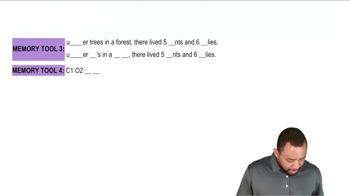
    'Oxford, city, ice crates, kegs, and such contain succulent foamy milk' helps recall the order of intermediates.
  • Which reactions in the Citric Acid Cycle produce NADH?

    Reactions 3, 4, and 8 produce NADH.
  • What is the role of dehydrogenase enzymes in the Citric Acid Cycle?

    Dehydrogenases catalyze oxidation reactions, facilitating the transfer of electrons to NAD+ or FAD.
  • How many times does the Citric Acid Cycle turn for each glucose molecule, and why?

    It turns twice per glucose molecule because each glucose yields two acetyl CoA molecules.
  • What are the three main high-energy molecules produced by the Citric Acid Cycle?

    The cycle produces NADH, FADH2, and ATP (or GTP).