 Back
BackTest for Ions and Gases definitions
 14:42
14:42
Terms in this set (15)
Anion
A negatively charged ion commonly identified in solution by specific chemical tests producing precipitates or gases.
Halogen
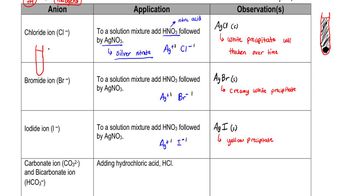
A group of elements in Group 7A, including chloride, bromide, and iodide, often forming colored precipitates with silver nitrate.
Precipitate
A solid formed in a solution during a chemical reaction, often used as evidence for the presence of certain ions.
Silver Nitrate
A reagent that reacts with halide ions to produce colored precipitates, aiding in their identification.
Nitric Acid
An acid added before silver nitrate to remove interfering ions, ensuring accurate halide detection.
Carbonate
An ion that reacts with hydrochloric acid to release carbon dioxide gas and forms a white precipitate with magnesium sulfate.
Bicarbonate
Also known as hydrogen carbonate, this ion releases carbon dioxide with acid but does not form a precipitate with magnesium sulfate.
Sulfate
An ion producing a white precipitate with barium chloride; distinguished from bisulfate by heating or sodium carbonate tests.
Bisulfate
Also called hydrogen sulfate, this ion forms a white precipitate with barium chloride and releases more CO2 with sodium carbonate.
Sulfite
An ion that reacts with hydrochloric acid to produce sulfur dioxide gas, recognized by its strong, unpleasant odor.
Nitrate
An ion detected by the brown ring test, which forms a characteristic brown ring at the interface in a test tube.
Brown Ring Test
A procedure using iron(II) sulfate and sulfuric acid to confirm nitrate presence by forming a brown ring.
Barium Chloride
A reagent that reacts with sulfate or bisulfate ions to produce a white precipitate, aiding in their identification.
Magnesium Sulfate
A chemical used to distinguish carbonate from bicarbonate by forming a white precipitate only with carbonate.
Sulfur Dioxide
A pungent gas produced when sulfite ions react with acid, serving as an indicator for their presence.