Back

Rate Law (Simplified) quiz

Control buttons has been changed to "navigation" mode.
1/15
  • What does the rate law relate in a chemical reaction?

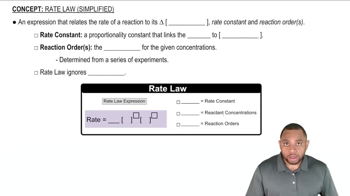
    The rate law relates the reaction rate to the change in concentration of reactants, the rate constant, and the reaction order.
  • What does the triangle symbol (Δ) represent in the context of rate law?

    The triangle symbol represents the change in concentration, calculated as final minus initial.
  • What do the brackets [ ] indicate in a rate law expression?

    Brackets indicate the concentration of reactants, usually measured in molarity.
  • What is the role of the rate constant (k) in the rate law?

    The rate constant (k) is a proportionality constant that links the reaction rate to the concentration of reactants.
  • How are reaction orders (exponents) determined in rate law?

    Reaction orders are determined experimentally by analyzing how changes in reactant concentrations affect the reaction rate.
  • Does the rate law include products in its expression?

    No, the rate law only includes reactants and ignores products.
  • What is the general form of the rate law for a reaction with two reactants, A and B?

    The general form is rate = k[A]^x[B]^y, where x and y are the reaction orders for A and B.
  • What do the variables x and y represent in the rate law expression?

    x and y represent the reaction orders for reactants A and B, respectively.
  • Can the rate law expression include more than two reactants?

    Yes, the rate law can include additional reactants, such as C or Z, each with their own reaction order.
  • How is the concentration of reactants typically measured in rate law?

    Concentration is typically measured in units of molarity (moles per liter).
  • Why is understanding rate law important in chemistry?

    Understanding rate law is essential for analyzing reaction kinetics and enzyme activation energy.
  • What does the exponent in the rate law indicate about a reactant?

    The exponent indicates how changes in the reactant's concentration affect the reaction rate.
  • If a reaction has only one reactant, how is the rate law written?

    The rate law is written as rate = k[A]^x, where A is the reactant and x is its reaction order.
  • What is the significance of the rate constant (k) in the rate law?

    The rate constant determines the proportionality between the rate and the concentrations raised to their respective orders.
  • How do textbooks sometimes denote reaction orders besides x and y?

    Textbooks may use prime or double prime notation, but x, y, and z are commonly used for simplicity.