Skip to main content
GOB Chemistry
My Course
Learn
Exam Prep
AI Tutor
Study Guides
Textbook Solutions
Flashcards
Explore
Try the app
My Course
Learn
Exam Prep
AI Tutor
Study Guides
Textbook Solutions
Flashcards
Explore
Try the app
Back
Protein Denaturation quiz
You can tap to flip the card.
What is protein denaturation?
You can tap to flip the card.
👆
What is protein denaturation?
Protein denaturation is the disruption of quaternary, tertiary, or secondary structures, altering the protein's shape and function.
Track progress
Control buttons has been changed to "navigation" mode.
1/15
Related flashcards
Related practice
Recommended videos
Protein Denaturation definitions
Protein Denaturation
15 Terms
Protein Denaturation
18. Amino Acids and Proteins
Topic
Summary of Protein Structure
18. Amino Acids and Proteins
7 problems
Topic
KeyshawnDavis
18. Amino Acids and Proteins - Part 1 of 2
6 topics
13 problems
Chapter
Jules
18. Amino Acids and Proteins - Part 2 of 2
5 topics
13 problems
Chapter
Jules
Guided course
2:08
Protein Denaturation Concept 1
4
views
Guided course
1:47
Protein Denaturation Example 1
3
views
Guided course
2:46
Protein Denaturation Concept 2
3
views
Terms in this set (15)
Hide definitions
What is protein denaturation?
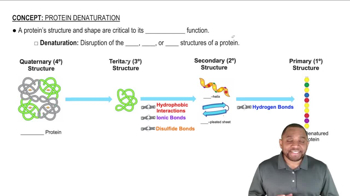
Protein denaturation is the disruption of quaternary, tertiary, or secondary structures, altering the protein's shape and function.
Which protein structures are disrupted during denaturation?
Quaternary, tertiary, and secondary structures are disrupted during denaturation.
How does denaturation affect protein function?
Denaturation changes the protein's shape, which directly affects its function.
What is the relationship between protein shape and function?
Protein shape determines its function; altering the shape disrupts its activity.
What types of bonds are broken when moving from quaternary to tertiary structure during denaturation?
Hydrophobic interactions, ionic bonds, and disulfide bonds are broken.
What remains after breaking down a protein to its secondary structure?
The protein is left with alpha helix or beta pleated sheet configurations.
Which bonds are broken to reach the primary structure from the secondary structure?
Hydrogen bonds are broken to reach the primary structure.
What does a fully denatured protein represent?
A fully denatured protein is no longer active and has lost its native conformation.
What are four methods that can cause protein denaturation?
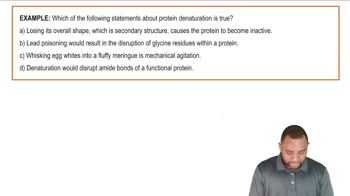
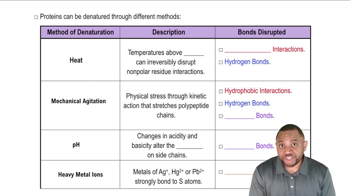
Heat, mechanical agitation, pH changes, and heavy metal ions can cause denaturation.
How does heat above 50°C denature proteins?
Heat irreversibly disrupts hydrophobic interactions and hydrogen bonds.
What is an everyday example of protein denaturation by heat?
Frying an egg is an example, as the protein structure cannot be restored afterward.
How does mechanical agitation denature proteins?
Mechanical agitation stretches polypeptide chains, disrupting hydrophobic interactions, hydrogen bonds, and ionic bonds.
How do pH changes affect protein structure?
pH changes alter the charges on side chains, disrupting ionic bonds and affecting acidic or basic amino acids.
Which heavy metal ions are known to denature proteins?
Silver, mercury (II), and lead (II) ions denature proteins by bonding to sulfur atoms.
Why are disulfide bonds important in protein structure?
Disulfide bonds, formed by cysteine amino acids, are crucial for maintaining protein structure and are disrupted by heavy metal ions.
 BackBack

 2:08
2:08