Skip to main content
GOB Chemistry
My Course
Learn
Exam Prep
AI Tutor
Study Guides
Textbook Solutions
Flashcards
Explore
Try the app
My Course
Learn
Exam Prep
AI Tutor
Study Guides
Textbook Solutions
Flashcards
Explore
Try the app
Back
Oxidation of Fatty Acids quiz
You can tap to flip the card.
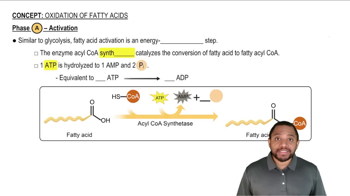
What enzyme catalyzes the activation of fatty acids in the first phase of fatty acid oxidation?
You can tap to flip the card.
👆
What enzyme catalyzes the activation of fatty acids in the first phase of fatty acid oxidation?
Acyl CoA synthetase catalyzes the activation of fatty acids, converting them to fatty acyl CoA using ATP.
Track progress
Control buttons has been changed to "navigation" mode.
1/15
Related flashcards
Related practice
Recommended videos
Oxidation of Fatty Acids definitions
Oxidation of Fatty Acids
15 Terms
Oxidation of Fatty Acids
24. Lipid Metabolism
7 problems
Topic
KeyshawnDavis
Total Energy from Fatty Acids
24. Lipid Metabolism
4 problems
Topic
Laura
24. Lipid Metabolism - Part 1 of 2
8 topics
15 problems
Chapter
KeyshawnDavis
24. Lipid Metabolism - Part 2 of 2
1 topic
3 problems
Chapter
Nicole
Guided course
1:29
Oxidation of Fatty Acids Concept 1
3
views
Guided course
1:29
Oxidation of Fatty Acids Concept 3
3
views
Guided course
1:25
Oxidation of Fatty Acids Example 3
1
views
Terms in this set (15)
Hide definitions
What enzyme catalyzes the activation of fatty acids in the first phase of fatty acid oxidation?
Acyl CoA synthetase catalyzes the activation of fatty acids, converting them to fatty acyl CoA using ATP.
How many ATP equivalents are consumed during the activation of a fatty acid?
Two ATP equivalents are consumed, as ATP is hydrolyzed to AMP and two inorganic phosphates.
Why can't fatty acyl CoA cross the mitochondrial membrane directly?
Fatty acyl CoA cannot cross the mitochondrial membrane due to its size and charge, so it must be converted to fatty acyl carnitine for transport.
What role does carnitine play in fatty acid oxidation?
Carnitine acts as a carrier, allowing the fatty acyl group to cross the mitochondrial membrane by forming fatty acyl carnitine.
Which enzyme transfers the fatty acyl group from CoA to carnitine?
Carnitine acyl transferase transfers the fatty acyl group from CoA to carnitine.
What happens to carnitine after it delivers the fatty acyl group into the mitochondrial matrix?
Carnitine is released and returns to the cytosol to participate in another transport cycle.
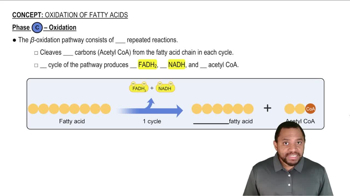
How many repeated reactions are involved in one cycle of beta oxidation?
There are four repeated reactions in each cycle of beta oxidation.
What are the main products of one cycle of beta oxidation?
One cycle produces one FADH2, one NADH, and one acetyl CoA.
Which enzyme catalyzes the first reaction of beta oxidation and what is produced?
Acyl CoA dehydrogenase catalyzes the first reaction, producing FADH2 and a trans double bond between the alpha and beta carbons.
What is the function of enoyl CoA hydratase in beta oxidation?
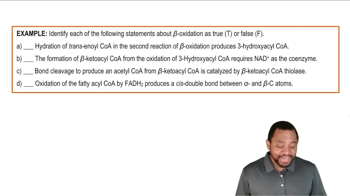
Enoyl CoA hydratase adds water across the alpha-beta double bond, placing a hydroxyl group on the beta carbon.
What is the product of the hydration step in beta oxidation?
The product is 3-hydroxyacyl CoA, with a hydroxyl group on the beta (third) carbon.
Which enzyme oxidizes the beta hydroxyl group to a ketone in beta oxidation?
3-hydroxyacyl CoA dehydrogenase oxidizes the beta hydroxyl group to a ketone, producing NADH.
What is the final step of a beta oxidation cycle and what does it produce?
The final step is cleavage by beta-ketoacyl CoA thiolase, producing acetyl CoA and a shortened fatty acyl CoA.
How is the number of beta oxidation cycles for a fatty acid determined?
The number of cycles is equal to the number of carbons divided by two, minus one.
How many acetyl CoA molecules are produced from complete oxidation of an 8-carbon fatty acid?
Four acetyl CoA molecules are produced, as the number of acetyl CoA equals the number of carbons divided by two.
 BackBack
 1:29
1:29