Skip to main content
GOB Chemistry
My Course
Learn
Exam Prep
AI Tutor
Study Guides
Textbook Solutions
Flashcards
Explore
Try the app
My Course
Learn
Exam Prep
AI Tutor
Study Guides
Textbook Solutions
Flashcards
Explore
Try the app
Back
Models of Enzyme Action quiz
You can tap to flip the card.
What are the two main models that describe enzyme-substrate interaction?
You can tap to flip the card.
👆
What are the two main models that describe enzyme-substrate interaction?
The two main models are the lock and key model and the induced fit model.
Track progress
Control buttons has been changed to "navigation" mode.
1/15
Related flashcards
Related practice
Recommended videos
Models of Enzyme Action definitions
Models of Enzyme Action
13 Terms
Models of Enzyme Action
19. Enzymes
7 problems
Topic
KeyshawnDavis
Factors Affecting Enzyme Activity
19. Enzymes
7 problems
Topic
Laura
19. Enzymes
9 topics
15 problems
Chapter
Laura
Guided course
2:39
Models of Enzyme Action Concept 1
3
views
Guided course
1:26
Models of Enzyme Action Example 1
1
views
Terms in this set (15)
Hide definitions
What are the two main models that describe enzyme-substrate interaction?
The two main models are the lock and key model and the induced fit model.
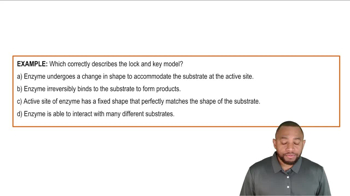
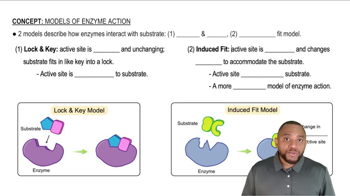
In the lock and key model, how is the enzyme's active site described?
The active site is rigid and unchanging in the lock and key model.
How does the substrate fit into the enzyme in the lock and key model?
The substrate fits precisely into the active site, like a key fits into a lock.
What does the lock and key model imply about the specificity of enzyme-substrate interaction?
It implies a very specific and unchanging interaction between the enzyme and substrate.
How does the active site compare to the substrate in the lock and key model?
The active site is identical in shape to the substrate in the lock and key model.
What is the main feature of the induced fit model regarding the active site?
The active site is flexible and can change shape to accommodate the substrate.
How does the active site interact with the substrate in the induced fit model?
The active site adapts its shape to fit the substrate, allowing a dynamic interaction.
Is the active site a perfect match to the substrate in the induced fit model?
No, the active site only resembles the substrate and is not an identical match.
Which model is considered a more accurate representation of most enzyme actions?
The induced fit model is considered more accurate for most enzyme actions.
What happens to the enzyme's active site when the substrate binds in the induced fit model?
The enzyme's active site changes shape to accommodate the substrate.
What is formed when the enzyme and substrate interact in either model?
An enzyme-substrate complex is formed.
How does the lock and key model view the complementarity between enzyme and substrate?
It views them as perfectly complementary in shape.
How does the induced fit model view the complementarity between enzyme and substrate?
It sees them as similar but not identical, requiring the active site to adjust.
Why is the lock and key model less accurate for most enzyme-substrate interactions?
Because most enzymes and substrates do not match up perfectly in shape.
What allows the enzyme to form a complex with the substrate in the induced fit model?
The flexibility and ability of the active site to change shape allows complex formation.
 BackBack
 2:39
2:39