Skip to main content
GOB Chemistry
My Course
Learn
Exam Prep
AI Tutor
Study Guides
Textbook Solutions
Flashcards
Explore
Try the app
My Course
Learn
Exam Prep
AI Tutor
Study Guides
Textbook Solutions
Flashcards
Explore
Try the app
Back
Lipoproteins for Transport definitions
You can tap to flip the card.
Lipoprotein
You can tap to flip the card.
👆
Lipoprotein
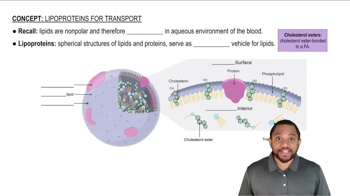
Spherical complex of lipids and proteins enabling lipid transport in blood, overcoming lipid insolubility in aqueous environments.
Track progress
Control buttons has been changed to "navigation" mode.
1/14
Related flashcards
Related practice
Recommended videos
Lipoproteins for Transport quiz
Lipoproteins for Transport
15 Terms
Lipoproteins for Transport
24. Lipid Metabolism
5 problems
Topic
Nicole
Glycerol Metabolism
24. Lipid Metabolism
4 problems
Topic
Nicole
24. Lipid Metabolism - Part 1 of 2
8 topics
15 problems
Chapter
KeyshawnDavis
24. Lipid Metabolism - Part 2 of 2
1 topic
3 problems
Chapter
Nicole
Guided course
1:39
Lipoproteins for Transport Concept 1
4
views
Guided course
1:27
Lipoproteins for Transport Example 1
1
views
Guided course
3:52
Lipoproteins for Transport Concept 2
1
views
Terms in this set (14)
Hide definitions
Lipoprotein
Spherical complex of lipids and proteins enabling lipid transport in blood, overcoming lipid insolubility in aqueous environments.
Chylomicron
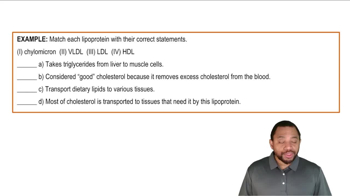
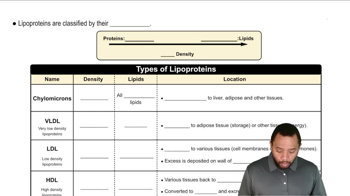
Largest, least dense transporter carrying dietary lipids from intestines to liver, adipose tissue, and other tissues.
VLDL
Very low density particle originating from the liver, mainly transporting triglycerides to adipose tissue or other tissues.
LDL
Moderate density carrier primarily moving cholesterol from liver to tissues; excess can accumulate in artery walls.
HDL
Most dense transporter collecting cholesterol from tissues and returning it to the liver for conversion to bile and excretion.
Cholesterol Ester
Formed by cholesterol bonded to a fatty acid, found in the nonpolar interior of lipoproteins.
Triglyceride
Major lipid component stored or used for energy, transported within chylomicrons and VLDL.
Phospholipid
Molecule forming the polar surface of lipoproteins, contributing to their structural stability in blood.
Protein to Lipid Ratio
Proportion determining lipoprotein density; higher protein content results in increased density.
Density
Classification factor for lipoproteins, increasing with greater protein content relative to lipid content.
Nonpolar Interior
Central region of lipoproteins housing hydrophobic molecules like cholesterol esters and triglycerides.
Polar Surface
Outer layer of lipoproteins composed of proteins and phospholipids, interacting with the aqueous blood environment.
Adipose Tissue
Body storage site for lipids delivered by chylomicrons and VLDL, serving as an energy reserve.
Bile
Substance produced in the liver from cholesterol, aiding in fat digestion and excreted after HDL transport.
 BackBack
 1:39
1:39