Back

Ions and the Octet Rule quiz

Control buttons has been changed to "navigation" mode.
1/15
  • What is the main goal of main group elements in chemical reactions?

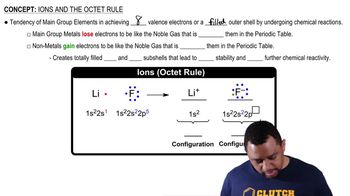
    Main group elements aim to achieve eight valence electrons or a filled outer shell for stability.
  • How do main group metals achieve a stable electron configuration?

    Main group metals lose electrons to resemble the electron configuration of the noble gas before them in the periodic table.
  • Which noble gas does sodium aim to mimic by losing an electron?

    Sodium aims to mimic neon by losing one electron, resulting in ten electrons like neon.
  • How do main group non-metals achieve a stable electron configuration?

    Main group non-metals gain electrons to resemble the electron configuration of the noble gas after them in the periodic table.
  • Which noble gas does sulfur aim to mimic by gaining electrons?

    Sulfur aims to mimic argon by gaining two electrons, resulting in eighteen electrons like argon.
  • Why do elements seek filled s and p subshells?

    Filled s and p subshells lead to greater stability and reduced chemical reactivity.
  • What happens to lithium’s electron configuration when it loses one electron?

    Lithium’s electron configuration becomes similar to helium, with a completely filled s subshell.
  • What happens to fluorine’s electron configuration when it gains one electron?

    Fluorine’s electron configuration becomes similar to neon, with a completely filled p subshell.
  • What is the maximum number of electrons an s subshell can hold?

    An s subshell can hold a maximum of two electrons.
  • What is the maximum number of electrons a p subshell can hold?

    A p subshell can hold a maximum of six electrons.
  • What is the result of lithium and fluorine becoming ions?

    Both ions achieve electron configurations similar to their nearest noble gases, increasing their stability.
  • Why are noble gases considered very stable?

    Noble gases are stable because they have filled outer shells of electrons.
  • From which shell are electrons removed when forming a metal cation?

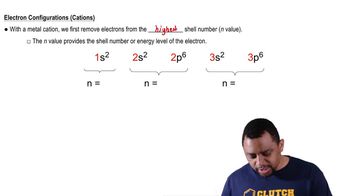
    Electrons are removed from the highest shell number (highest n value) when forming a metal cation.
  • How is the shell number (n value) determined in electron configurations?

    The shell number is indicated by the number before the subshell letter in the electron configuration.
  • In what order are electrons removed from the subshells when forming a cation?

    Electrons are removed from the subshell with the highest n value, starting with p before s within the same shell.