Back

Intro to Metabolism quiz

Control buttons has been changed to "navigation" mode.
1/15
  • What is metabolism in biological terms?

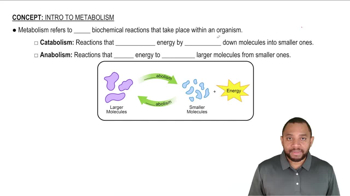
    Metabolism refers to all biochemical reactions that take place within an organism.
  • What is the main difference between catabolism and anabolism?

    Catabolism breaks down molecules to release energy, while anabolism uses energy to build larger molecules from smaller ones.
  • What type of metabolic pathway breaks down molecules and releases energy?

    Catabolic pathways break down molecules and release energy.
  • What type of metabolic pathway builds larger molecules and requires energy?

    Anabolic pathways build larger molecules from smaller ones and require energy input.
  • What is a metabolic pathway?

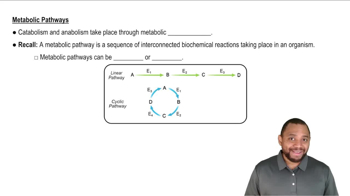
    A metabolic pathway is a sequence of interconnected biochemical reactions in an organism.
  • What are the two main types of metabolic pathways?

    Metabolic pathways can be linear or cyclic.
  • How many stages are involved in the catabolism of food?

    There are four stages involved in the catabolism of food.
  • What happens during Stage 1 of food catabolism?

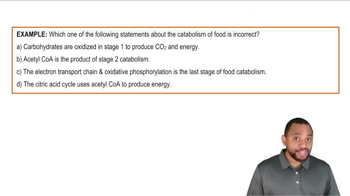
    Stage 1 is digestion, where proteins, carbohydrates, and lipids are broken down into amino acids, monosaccharides, and fatty acids.
  • What is formed during Stage 2 of catabolism?

    Acetyl CoA is formed during Stage 2 of catabolism.
  • Which stages of catabolism are considered the common metabolic pathway?

    Stages 3 and 4 are considered the common metabolic pathway.
  • Why are Stages 3 and 4 called the common metabolic pathway?

    Because they are identical for the catabolism of all food types, regardless of the original molecule.
  • What occurs during Stage 3 of catabolism?

    Stage 3 is the citric acid cycle, where electron carriers like NADH and FADH2, ATP, and CO2 are produced.
  • What is the main process in Stage 4 of catabolism?

    Stage 4 involves the electron transport chain and oxidative phosphorylation, leading to ATP production.
  • Why do Stages 1 and 2 of catabolism differ for different food types?

    Because different enzymes and pathways are needed to break down proteins, carbohydrates, and lipids into their basic units.
  • What is the predominant energy production pathway in the body called?

    The predominant energy production pathway is aerobic respiration, which requires oxygen.