Skip to main content
GOB Chemistry
My Course
Learn
Exam Prep
AI Tutor
Study Guides
Textbook Solutions
Flashcards
Explore
Try the app
My Course
Learn
Exam Prep
AI Tutor
Study Guides
Textbook Solutions
Flashcards
Explore
Try the app
Back
Intro to Fatty Acid Oxidation definitions
You can tap to flip the card.
Fatty Acid Oxidation
You can tap to flip the card.
👆
Fatty Acid Oxidation
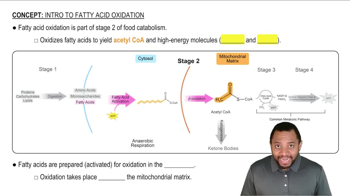
Stage two metabolic process in mitochondria breaking down fatty acids to yield Acetyl CoA, NADH, and FADH2.
Track progress
Control buttons has been changed to "navigation" mode.
1/14
Related flashcards
Related practice
Recommended videos
Intro to Fatty Acid Oxidation quiz
Intro to Fatty Acid Oxidation
15 Terms
Intro to Fatty Acid Oxidation
24. Lipid Metabolism
2 problems
Topic
Nicole
Oxidation of Fatty Acids
24. Lipid Metabolism
7 problems
Topic
KeyshawnDavis
24. Lipid Metabolism - Part 1 of 2
8 topics
15 problems
Chapter
KeyshawnDavis
24. Lipid Metabolism - Part 2 of 2
1 topic
3 problems
Chapter
Nicole
Guided course
1:22
Intro to Fatty Acid Oxidation Example 1
Guided course
1:46
Intro to Fatty Acid Oxidation Concept 2
1
views
Guided course
1:45
Intro to Fatty Acid Oxidation Concept 1
3
views
Terms in this set (14)
Hide definitions
Fatty Acid Oxidation
Stage two metabolic process in mitochondria breaking down fatty acids to yield Acetyl CoA, NADH, and FADH2.
Mitochondrial Matrix
Intracellular location where beta oxidation of fatty acids and subsequent energy production steps occur.
Fatty Acyl CoA
Activated fatty acid form produced in the cytosol, essential for entry into mitochondrial oxidation.
ATP
Energy molecule consumed during fatty acid activation, enabling conversion to fatty acyl CoA.
Cytosol
Cellular compartment where fatty acids are initially activated before mitochondrial transport.
Beta Oxidation
Pathway in mitochondria that sequentially cleaves fatty acid chains, generating Acetyl CoA and high-energy molecules.
Acetyl CoA
Two-carbon molecule produced from fatty acid breakdown, serving as a key substrate for ATP generation or ketone synthesis.
NADH
High-energy electron carrier generated during fatty acid oxidation, later used for ATP production.
FADH2
Reduced coenzyme formed during beta oxidation, contributing electrons to the mitochondrial electron transport chain.
Ketone Bodies
Alternative energy molecules synthesized from Acetyl CoA when not used for ATP production.
Carnitine Shuttle
Transport system that moves fatty acyl groups from the cytosol into the mitochondrial matrix for oxidation.
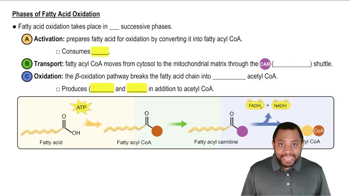
Activation
Initial phase of fatty acid oxidation involving conversion of fatty acids to fatty acyl CoA using ATP.
Transport
Phase where fatty acyl CoA is transferred into mitochondria via the carnitine shuttle.
Oxidation
Final phase where fatty acid chains are broken down, producing Acetyl CoA, NADH, and FADH2.
 BackBack
 1:22
1:22