Skip to main content
GOB Chemistry
My Course
Learn
Exam Prep
AI Tutor
Study Guides
Textbook Solutions
Flashcards
Explore
Try the app
My Course
Learn
Exam Prep
AI Tutor
Study Guides
Textbook Solutions
Flashcards
Explore
Try the app
Back
Intro to Carbohydrate Metabolism definitions
You can tap to flip the card.
Digestion
You can tap to flip the card.
👆
Digestion
Conversion of food into small molecules through both mechanical actions and biochemical hydrolysis.
Track progress
Control buttons has been changed to "navigation" mode.
1/15
Related flashcards
Related practice
Recommended videos
Intro to Carbohydrate Metabolism quiz
Intro to Carbohydrate Metabolism
15 Terms
Intro to Carbohydrate Metabolism
22. Carbohydrate Metabolism
5 problems
Topic
Nicole
Intro to Glycolysis
22. Carbohydrate Metabolism
1 problem
Topic
Nicole
22. Carbohydrate Metabolism
9 topics
15 problems
Chapter
Nicole
Guided course
1:51
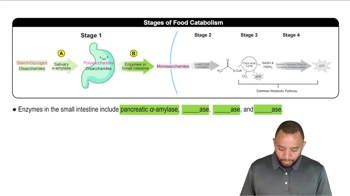
Intro To Carbohydrate Metabolism Concept 2
1
views
Guided course
0:50
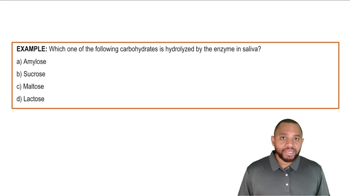
Intro To Carbohydrate Metabolism Example 1
1
views
Guided course
1:53
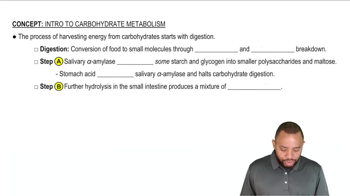
Intro To Carbohydrate Metabolism Concept 1
1
views
Terms in this set (15)
Hide definitions
Digestion
Conversion of food into small molecules through both mechanical actions and biochemical hydrolysis.
Mechanical Breakdown
Physical process involving chewing and grinding food into smaller pieces to aid further processing.
Biochemical Breakdown
Hydrolysis-driven process that reduces large molecules into smaller, absorbable units.
Salivary Alpha Amylase
Enzyme in the mouth initiating starch and glycogen hydrolysis into smaller polysaccharides and maltose.
Polysaccharide
Polymer composed of multiple glucose units linked by glycosidic bonds, such as starch or glycogen.
Maltose
Disaccharide consisting of two glucose molecules joined by a glycosidic linkage.
Oligosaccharide
Carbohydrate fragment containing 3 to 10 monosaccharide units, often produced during starch breakdown.
Monosaccharide
Simple sugar molecule, such as glucose, fructose, or galactose, resulting from complete carbohydrate hydrolysis.
Pancreatic Alpha Amylase
Enzyme in the small intestine that continues starch and glycogen hydrolysis into smaller sugars.
Maltase
Small intestine enzyme responsible for splitting maltose into two glucose molecules.
Sucrase
Digestive enzyme that catalyzes the breakdown of sucrose into glucose and fructose.
Lactase
Enzyme that hydrolyzes lactose into glucose and galactose in the small intestine.
Acetyl CoA
Central metabolic intermediate formed from carbohydrate breakdown, entering the Krebs cycle.
Krebs Cycle
Series of reactions in mitochondria generating electron carriers, ATP, and carbon dioxide from Acetyl CoA.
Electron Transport Chain
Mitochondrial process using electron carriers to produce large amounts of ATP via oxidative phosphorylation.
 BackBack
 1:51
1:51