Skip to main content
GOB Chemistry
My Course
Learn
Exam Prep
AI Tutor
Study Guides
Textbook Solutions
Flashcards
Explore
Try the app
My Course
Learn
Exam Prep
AI Tutor
Study Guides
Textbook Solutions
Flashcards
Explore
Try the app
Back
Intro to Amino Acids quiz
You can tap to flip the card.
What are the three main groups attached to the alpha carbon in an amino acid?
You can tap to flip the card.
👆
What are the three main groups attached to the alpha carbon in an amino acid?
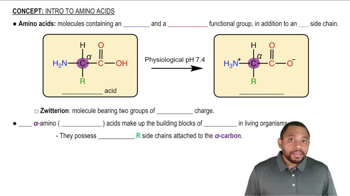
The alpha carbon is attached to an amino group, a carboxyl group, and a variable R side chain.
Track progress
Control buttons has been changed to "navigation" mode.
1/15
Related flashcards
Related practice
Recommended videos
Intro to Amino Acids definitions
Intro to Amino Acids
13 Terms
Intro to Amino Acids
18. Amino Acids and Proteins
6 problems
Topic
Jules
Amino Acid Three Letter Codes
18. Amino Acids and Proteins
1 problem
Topic
Ernest
18. Amino Acids and Proteins - Part 1 of 2
6 topics
13 problems
Chapter
Jules
18. Amino Acids and Proteins - Part 2 of 2
5 topics
13 problems
Chapter
Jules
Guided course
2:11
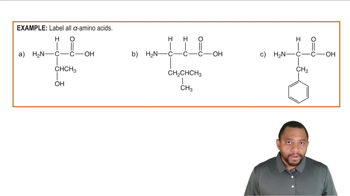
Intro to Amino Acids Example 1
4
views
Guided course
3:04
Intro to Amino Acids Concept 1
4
views
Terms in this set (15)
Hide definitions
What are the three main groups attached to the alpha carbon in an amino acid?
The alpha carbon is attached to an amino group, a carboxyl group, and a variable R side chain.
What is the significance of the alpha carbon in amino acids?
The alpha carbon is central and connects the amino group, carboxyl group, hydrogen atom, and R group.
At physiological pH, what form do amino acids primarily exist in?
They exist in the zwitterion form, with both a positive and a negative charge.
What charge does the amino group carry at physiological pH?
The amino group is protonated and carries a positive charge (NH3+).
What happens to the carboxyl group of an amino acid at physiological pH?
The carboxyl group loses a proton and becomes a negatively charged carboxylate anion (COO-).
What is a zwitterion?
A zwitterion is a molecule with both positive and negative charges on different groups.
How many standard alpha amino acids are there?
There are 20 standard alpha amino acids.
What distinguishes one amino acid from another?
The type of R group attached to the alpha carbon distinguishes each amino acid.
What is the role of amino acids in living organisms?
Amino acids are the building blocks of proteins in living organisms.
What does the R group in an amino acid represent?
The R group is a variable side chain that can be a hydrogen, carbon, or a more complex group.
How many different R groups are found in standard amino acids?
There are 20 different R groups, one for each standard amino acid.
What is the generic structure of an alpha amino acid?
It consists of an alpha carbon attached to an amino group, carboxyl group, hydrogen atom, and an R group.
Why does the amino group become positively charged at physiological pH?
It gains a proton (H+), resulting in a positively charged NH3+ group.
Why does the carboxyl group become negatively charged at physiological pH?
It loses a proton (H+), forming a carboxylate anion (COO-).
What is the pH value considered physiological for amino acids?
Physiological pH is approximately 7.4.
 BackBack

 2:11
2:11