Skip to main content
GOB Chemistry
My Course
Learn
Exam Prep
AI Tutor
Study Guides
Textbook Solutions
Flashcards
Explore
Try the app
My Course
Learn
Exam Prep
AI Tutor
Study Guides
Textbook Solutions
Flashcards
Explore
Try the app
Back
Glycerol Metabolism quiz
You can tap to flip the card.
What is the main purpose of glycerol metabolism?
You can tap to flip the card.
👆
What is the main purpose of glycerol metabolism?
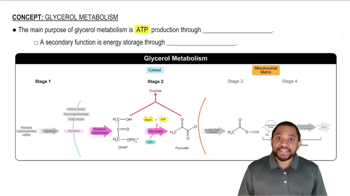
The main purpose is ATP production through glycolysis.
Track progress
Control buttons has been changed to "navigation" mode.
1/15
Related flashcards
Related practice
Recommended videos
Glycerol Metabolism definitions
Glycerol Metabolism
15 Terms
Glycerol Metabolism
24. Lipid Metabolism
4 problems
Topic
Nicole
Intro to Fatty Acid Oxidation
24. Lipid Metabolism
2 problems
Topic
Nicole
24. Lipid Metabolism - Part 1 of 2
8 topics
15 problems
Chapter
KeyshawnDavis
24. Lipid Metabolism - Part 2 of 2
1 topic
3 problems
Chapter
Nicole
Guided course
1:20
Glycerol Metabolism Concept 2
3
views
Guided course
1:14
Glycerol Metabolism Concept 3
3
views
Guided course
1:30
Glycerol Metabolism Concept 1
1
views
Terms in this set (15)
Hide definitions
What is the main purpose of glycerol metabolism?
The main purpose is ATP production through glycolysis.
What is the secondary function of glycerol metabolism?
The secondary function is energy storage via gluconeogenesis.
What are the products of triglyceride hydrolysis?
Triglyceride hydrolysis produces glycerol and three fatty acids.
Where does glycerol travel after being released from triglycerides?
Glycerol travels to the liver for further metabolic reactions.
What is the first reaction in glycerol metabolism?
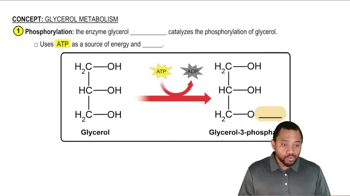
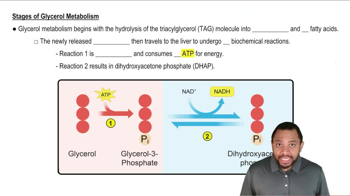
The first reaction is the phosphorylation of glycerol to glycerol 3-phosphate.
Which enzyme catalyzes the phosphorylation of glycerol?
Glycerol kinase catalyzes the phosphorylation of glycerol.
What molecule provides the phosphate group in the first reaction of glycerol metabolism?
ATP provides the phosphate group and is converted to ADP.
What is the product of the first reaction in glycerol metabolism?
The product is glycerol 3-phosphate.
What type of reaction is the second step of glycerol metabolism?
The second step is an oxidation reaction.
Which enzyme catalyzes the oxidation of glycerol 3-phosphate?
Glycerol 3-phosphate dehydrogenase catalyzes this reaction.
What is the product of the second reaction in glycerol metabolism?
The product is dihydroxyacetone phosphate (DHAP).
What coenzyme is reduced during the oxidation of glycerol 3-phosphate?
NAD+ is reduced to NADH during this reaction.
Into which metabolic pathways can DHAP enter after being formed?
DHAP can enter glycolysis to become pyruvate or gluconeogenesis to form glucose.
What class of enzyme is used in oxidation reactions like the second step of glycerol metabolism?
Dehydrogenase enzymes are used in oxidation reactions.
What happens to the secondary alcohol group in glycerol 3-phosphate during its oxidation?
The secondary alcohol is oxidized to a ketone, forming DHAP.
 BackBack
 1:20
1:20