Back

Ester Reactions: Acid-Catalyzed Hydrolysis definitions

Control buttons has been changed to "navigation" mode.
1/13
  • Ester

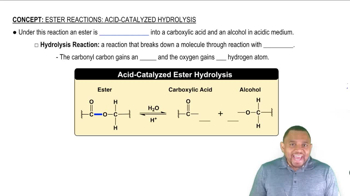
    A compound featuring a carbonyl group bonded to an oxygen atom, which is also bonded to another carbon chain.
  • Hydrolysis

    A chemical process where a molecule is split into two parts by the addition of water.
  • Acid Catalyst

    A substance, often H+, that increases the rate of a reaction without being consumed, especially in acidic conditions.
  • Carboxylic Acid

    A molecule containing a carbonyl and hydroxyl group on the same carbon, formed from ester hydrolysis.
  • Alcohol

    An organic compound with a hydroxyl group attached to a carbon atom, produced from ester hydrolysis.
  • Carbonyl Carbon

    The central carbon atom double-bonded to oxygen in a carbonyl group, crucial in ester reactivity.
  • Ester Bond

    A linkage between a carbonyl carbon and an oxygen atom, characteristic of esters and broken during hydrolysis.
  • Water

    A polar molecule acting as a reactant in hydrolysis, facilitating the breakdown of esters.
  • Acidic Medium

    A reaction environment with excess hydrogen ions, necessary for acid-catalyzed hydrolysis.
  • Oxygen Atom

    An element in esters that gains a hydrogen during hydrolysis, leading to alcohol formation.
  • Hydrogen Atom

    A particle added to the oxygen from the ester linkage, resulting in alcohol as a product.
  • Product

    A substance formed as a result of a chemical reaction, such as carboxylic acid or alcohol in ester hydrolysis.
  • Reactant

    A starting material in a chemical reaction, like ester or water in acid-catalyzed hydrolysis.