Back

Enantiomers vs Diastereomers definitions

Control buttons has been changed to "navigation" mode.
1/12
  • Stereoisomers

    Molecules sharing molecular formula and connectivity but differing in three-dimensional arrangement of atoms.
  • Chiral Molecules

    Structures that cannot be superimposed on their mirror images, often due to asymmetric carbon atoms.
  • Mirror Image

    A spatial arrangement that reflects another structure, appearing as its reversed counterpart.
  • Chiral Center

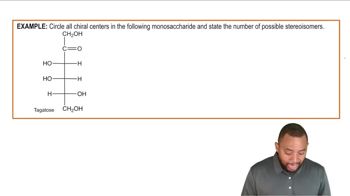
    An atom, typically carbon, bonded to four distinct groups, creating non-superimposable forms.
  • Configuration

    The specific spatial arrangement of atoms around a chiral center in a molecule.
  • Enantiomers

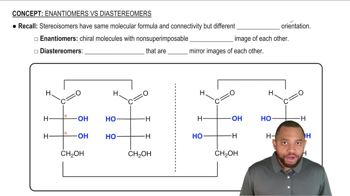
    Pairs of chiral molecules with opposite configurations at all chiral centers, forming non-superimposable mirror images.
  • Diastereomers

    Stereoisomers that are not mirror images, differing at some but not all chiral centers.
  • Molecular Formula

    A notation indicating the types and numbers of atoms present in a molecule.
  • Connectivity

    The sequence in which atoms are bonded together within a molecule.
  • Spatial Orientation

    The three-dimensional positioning of atoms or groups within a molecule.
  • Non-superimposable

    Describes objects or molecules that cannot be placed over each other to give a perfect match.
  • 2ⁿ Rule

    A formula used to calculate the maximum number of possible stereoisomers, where n is the number of chiral centers.