 Back
BackDistillation & Floatation definitions
 08:01
08:01
Terms in this set (15)
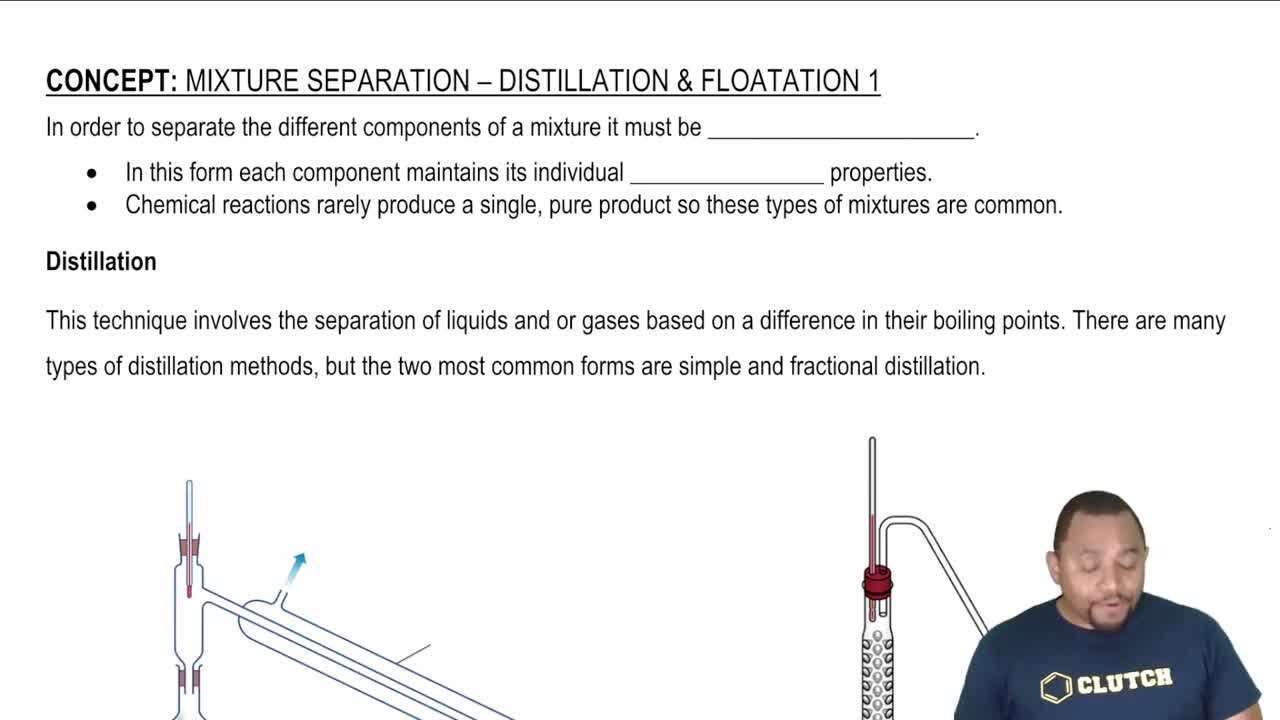
Distillation
A separation technique exploiting differences in boiling points to isolate components from liquid or gas mixtures.
Simple Distillation
A method using basic apparatus to separate substances with boiling points differing by more than 25°C, yielding faster but less pure results.
Fractional Distillation
A process using a fractional column with beads to separate substances with close boiling points, producing higher purity but less filtrate.
Boiling Point
The temperature at which a substance transitions from liquid to gas, crucial for determining separation methods.
Liebig Condenser
A cooling device with water-filled tubes that condenses vapor back into liquid during distillation.
Fractional Column
A vertical tube filled with beads, increasing surface area and promoting repeated vaporization-condensation cycles for better separation.
Bunsen Burner
A common heating source in distillation setups, providing controlled heat to vaporize mixtures.
Mole Fraction
A ratio expressing the amount of one component relative to the total in a mixture, often tracked during distillation.
Methanol
An alcohol with a boiling point of 67°C, often used as an example in distillation due to its significant boiling point difference from water.
Ethanol
An alcohol with a boiling point of 97°C, requiring fractional distillation for effective separation from water.
Distillate
The collected liquid product after condensation, whose purity depends on the distillation method used.
Condensation
The process where vapor cools and returns to liquid form, essential for collecting separated components.
Vaporization
The phase change from liquid to gas, initiating the separation of mixture components in distillation.
Surface Area
The total area available for vapor to interact with beads in a fractional column, enhancing separation efficiency.
Hot Plate
An alternative heating device to the Bunsen burner, used to supply heat in distillation setups.