Back

Amino Acid Catabolism: Carbon Atoms definitions

Control buttons has been changed to "navigation" mode.
1/14
  • Amino Acid Catabolism

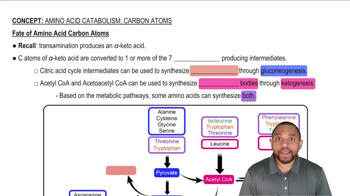
    Breakdown process where amino acid carbon skeletons are converted into energy-producing intermediates.
  • Glucogenic Amino Acids

    Subset that yields intermediates capable of synthesizing glucose via gluconeogenesis.
  • Ketogenic Amino Acids

    Subset that yields intermediates used exclusively for ketone body synthesis.
  • Gluconeogenesis

    Metabolic pathway generating glucose from non-carbohydrate precursors, including certain amino acids.
  • Ketogenesis

    Metabolic pathway producing ketone bodies from specific amino acid-derived intermediates.
  • Transamination

    Reaction transferring an amino group, resulting in the formation of an alpha-keto acid.
  • Alpha-Keto Acid

    Product of transamination, representing the carbon skeleton ready for further metabolic processing.
  • Citric Acid Cycle

    Central metabolic pathway where carbon skeletons are converted into energy and biosynthetic precursors.
  • Acetyl CoA

    Key intermediate funneled into the citric acid cycle or used for ketone body synthesis.
  • Pyruvate

    Three-carbon intermediate linking glycolysis, gluconeogenesis, and amino acid catabolism.
  • Oxaloacetate

    Four-carbon citric acid cycle intermediate essential for glucose synthesis.
  • Succinyl CoA

    Citric acid cycle intermediate formed from certain amino acids, crucial for energy production.
  • Fumarate

    Intermediate in the citric acid cycle, produced from the breakdown of specific amino acids.
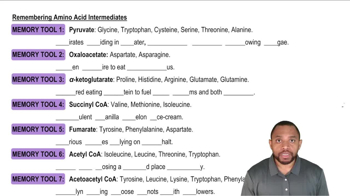
  • Memory Tools

    Mnemonic devices designed to help recall amino acid groupings and their metabolic fates.