Back

Amide Hydrolysis definitions

Control buttons has been changed to "navigation" mode.
1/13
  • Amide

    A compound featuring a nitrogen atom bonded to a carbonyl group, commonly found in proteins and synthetic materials.
  • Amide Bond

    A linkage connecting a nitrogen atom to a carbonyl carbon, crucial for the structure of peptides and proteins.
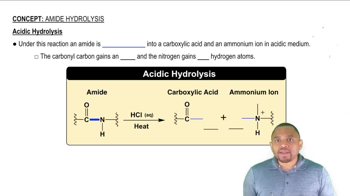
  • Acidic Hydrolysis

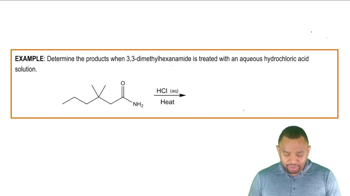
    A reaction using aqueous acid and heat to break an amide, yielding a carboxylic acid and an ammonium ion.
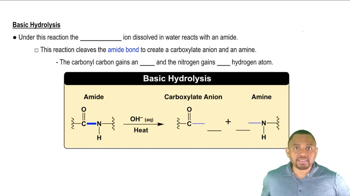
  • Basic Hydrolysis

    A process using hydroxide ions and heat to cleave an amide, producing a carboxylate anion and a neutral amine.
  • Carboxylic Acid

    A molecule with a carbonyl and hydroxyl group on the same carbon, formed from amides under acidic conditions.
  • Carboxylate Anion

    The conjugate base of a carboxylic acid, featuring a negatively charged oxygen, produced in basic hydrolysis.
  • Ammonium Ion

    A positively charged species formed when nitrogen in an amide gains two hydrogens during acidic hydrolysis.
  • Amine

    A compound with a nitrogen atom bonded to carbon or hydrogen, resulting from basic hydrolysis of an amide.
  • Aqueous Acid

    A solution of acid, such as hydrochloric acid, dissolved in water, used to facilitate acidic hydrolysis.
  • Hydroxide Ion

    A negatively charged ion (OH−) in water, responsible for breaking amide bonds in basic hydrolysis.
  • Carbonyl Group

    A functional group consisting of a carbon atom double-bonded to oxygen, central to amide structure and reactivity.
  • Conjugate Base

    A species formed when an acid loses a proton, such as the carboxylate anion from a carboxylic acid.
  • Heat

    An energy input required to drive both acidic and basic hydrolysis reactions of amides.