Skip to main content
GOB Chemistry
My Course
Learn
Exam Prep
AI Tutor
Study Guides
Textbook Solutions
Flashcards
Explore
Try the app
My Course
Learn
Exam Prep
AI Tutor
Study Guides
Textbook Solutions
Flashcards
Explore
Try the app
Back
Alcohol Reactions: Oxidation Reactions quiz
You can tap to flip the card.
What is the main oxidizing agent used in alcohol oxidation reactions discussed in the video?
You can tap to flip the card.
👆
What is the main oxidizing agent used in alcohol oxidation reactions discussed in the video?
The main oxidizing agents are Sodium Dichromate or Potassium Dichromate, with the dichromate ion being the key component.
Track progress
Control buttons has been changed to "navigation" mode.
1/15
Related flashcards
Related practice
Recommended videos
Alcohol Reactions: Oxidation Reactions definitions
Alcohol Reactions: Oxidation Reactions
13 Terms
Alcohol Reactions: Oxidation Reactions
14. Compounds with Oxygen or Sulfur
5 problems
Topic
Jules
Reactions of Thiols
14. Compounds with Oxygen or Sulfur
2 problems
Topic
Jules
14. Compounds with Oxygen or Sulfur
7 topics
15 problems
Chapter
Jules
Guided course
1:32
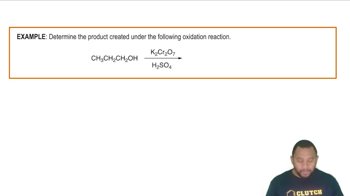
Alcohol Reactions Oxidation Reactions Example 1
2
views
Guided course
1:49
Alcohol Reactions: Oxidation Concept 1
1
views
Terms in this set (15)
Hide definitions
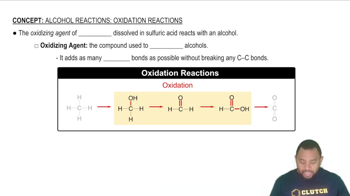
What is the main oxidizing agent used in alcohol oxidation reactions discussed in the video?
The main oxidizing agents are Sodium Dichromate or Potassium Dichromate, with the dichromate ion being the key component.
Why are sodium and potassium considered interchangeable in these oxidation reactions?
They are both Group 1A elements, so the important part is the dichromate, not the metal.
In what solvent are the oxidizing agents dissolved for alcohol oxidation?
The oxidizing agents are dissolved in sulfuric acid.
What is the primary goal of the oxidation process for alcohols?
The goal is to add as many carbon-oxygen bonds as possible without breaking any carbon-carbon bonds.
What part of the molecule is the focus during alcohol oxidation reactions?
The focus is on the shaded portion, which is the area of interest in organic chemistry for oxidation.
To what type of compounds can alcohols be oxidized?
Alcohols can be oxidized to carbonyl compounds, which may be aldehydes or ketones.
What can happen to carbonyl compounds if further oxidation occurs?
They can be further oxidized to form carboxylic acids.
What is the rule to follow when oxidizing alcohols?
Add as many carbon-oxygen bonds as possible without breaking any carbon-carbon bonds.
What functional groups are emphasized in alcohol oxidation reactions?
The functional groups are alcohols, aldehydes or ketones, and carboxylic acids.
What is the role of the dichromate ion in these reactions?
The dichromate ion acts as the actual oxidizing agent in the reaction.
What is the first product formed when a primary alcohol is oxidized?
The first product is typically an aldehyde.
What is the first product formed when a secondary alcohol is oxidized?
The first product is typically a ketone.
What happens if you continue to oxidize an aldehyde?
It can be further oxidized to a carboxylic acid.
Why is it important not to break carbon-carbon bonds during oxidation?
Breaking carbon-carbon bonds would change the carbon skeleton, which is not the goal of these oxidation reactions.
What is the significance of the shaded portion in the reaction diagram?
It highlights the area of the molecule undergoing oxidation, which is the main focus in organic chemistry.
 BackBack
 1:32
1:32