Phenacetin (shown in the margin) was once used in headache remedies but is now banned because of its potential for causing kidney damage. (a) Identify all the functional groups present in phenacetin. (b) Draw the structures of the carboxylic acid and amine needed to prepare phenacetin.
Ch.17 Carboxylic Acids and Their Derivatives
McMurry8th EditionFundamentals of General, Organic, and Biological ChemistryISBN: 9780134015187Not the one you use?Change textbook
Chapter 17, Problem 23b
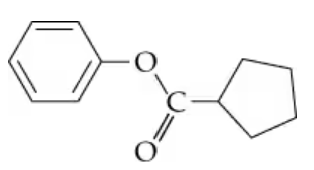
Draw the products you would obtain from acid-catalyzed hydrolysis of the following esters.
b. 
Verified step by step guidance1
Identify the ester functional group in the given molecule. An ester has the general structure RCOOR', where R and R' are alkyl or aryl groups.
Understand that acid-catalyzed hydrolysis of an ester involves breaking the ester bond (C-O bond) in the presence of water and an acid catalyst, such as HCl or H2SO4.
Write the reaction mechanism: The ester reacts with water (H2O), and the acid catalyst donates a proton (H+) to the carbonyl oxygen, making the carbonyl carbon more electrophilic and susceptible to nucleophilic attack by water.
After the nucleophilic attack, the intermediate undergoes proton transfers and bond rearrangements, leading to the cleavage of the ester bond. This produces two products: a carboxylic acid (RCOOH) and an alcohol (R'OH).
Draw the specific products for the given ester by identifying the R and R' groups in the structure. Replace the ester bond with a carboxylic acid group (RCOOH) and an alcohol group (R'OH) in the final products.

Verified video answer for a similar problem:
This video solution was recommended by our tutors as helpful for the problem above.
Was this helpful?
Key Concepts
Here are the essential concepts you must grasp in order to answer the question correctly.
Acid-Catalyzed Hydrolysis
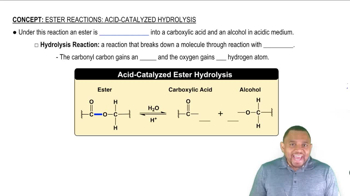
Acid-catalyzed hydrolysis is a chemical reaction where an ester reacts with water in the presence of an acid catalyst, typically a strong acid like sulfuric acid. This process breaks the ester bond, resulting in the formation of an alcohol and a carboxylic acid. The acid catalyst increases the reaction rate by protonating the carbonyl oxygen, making the carbon more electrophilic and susceptible to nucleophilic attack by water.
Recommended video:
Guided course
Acid-Catalyzed Ester Hydrolysis Concept 1
Esters
Esters are organic compounds formed from the reaction of an alcohol and a carboxylic acid, characterized by the functional group -COO-. They are commonly found in fats, oils, and natural fragrances. Understanding the structure of esters is crucial for predicting the products of their hydrolysis, as the specific alcohol and acid components will determine the final products formed during the reaction.
Recommended video:
Guided course
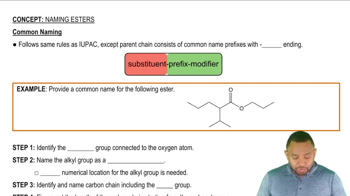
Common Naming: Esters Concept 2
Reaction Mechanism
The reaction mechanism outlines the step-by-step process by which reactants are converted into products. In the case of acid-catalyzed hydrolysis of esters, the mechanism involves protonation of the ester, nucleophilic attack by water, and subsequent deprotonation to yield the final products. Familiarity with the mechanism helps in understanding the conditions required for the reaction and the nature of the products formed.
Recommended video:
Guided course
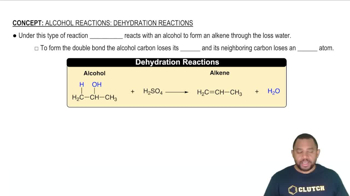
Alcohol Reactions: Dehydration Reactions Concept 1
Related Practice
Textbook Question
Textbook Question
Give the structure of the repeating units in the polymers that are formed in the reactions of the following compounds.
a.
Textbook Question
Draw the products you would obtain from acid-catalyzed hydrolysis of the following esters.
a. Isopropyl benzoate
Textbook Question
What carboxylic acids and amines result from hydrolysis of the following amides?
b. N,N-Dimethyl-p-nitrobenzamide
Textbook Question
What carboxylic acids and amines result from hydrolysis of the following amides?
a.
Textbook Question
Draw structures of the amides that can be made from the following reactants:
b.
