The concentration of cholesterol (C27H46O) in blood is approximately 5.0 mM. How many grams of cholesterol are in 250 mL of blood?
Ch.9 Solutions
McMurry8th EditionFundamentals of General, Organic, and Biological ChemistryISBN: 9780134015187Not the one you use?Change textbook
Chapter 9, Problem 11
The maximum amounts of lead and copper allowed in drinking water are 0.015 mg/kg for lead and 1.3 mg/kg for copper. Express these values in parts per million, and tell the maximum amount of each (in grams) allowed in 100 g of water.
Verified step by step guidance1
Step 1: Understand the relationship between parts per million (ppm) and mg/kg. Since 1 ppm is equivalent to 1 mg of solute per 1 kg of solution, the given values for lead (0.015 mg/kg) and copper (1.3 mg/kg) are already expressed in ppm. Therefore, lead is 0.015 ppm, and copper is 1.3 ppm.
Step 2: To find the maximum amount of lead allowed in 100 g of water, first convert the mass of water from grams to kilograms. Since 1 kg = 1000 g, 100 g of water is equivalent to 0.1 kg.
Step 3: Use the concentration of lead in ppm (0.015 ppm) to calculate the mass of lead in 0.1 kg of water. Multiply the concentration (in mg/kg) by the mass of water (in kg): \( \text{Mass of lead} = 0.015 \text{ mg/kg} \times 0.1 \text{ kg} \).
Step 4: Similarly, calculate the maximum amount of copper allowed in 100 g of water. Use the concentration of copper in ppm (1.3 ppm) and multiply it by the mass of water (in kg): \( \text{Mass of copper} = 1.3 \text{ mg/kg} \times 0.1 \text{ kg} \).
Step 5: Convert the calculated masses of lead and copper from milligrams to grams. Since 1 mg = 0.001 g, divide the results from Steps 3 and 4 by 1000 to express the masses in grams.

Verified video answer for a similar problem:
This video solution was recommended by our tutors as helpful for the problem above.
Video duration:
4mWas this helpful?
Key Concepts
Here are the essential concepts you must grasp in order to answer the question correctly.
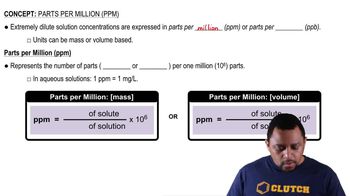
Parts Per Million (PPM)
Parts per million (PPM) is a unit of measurement used to describe the concentration of a substance in a solution. It indicates how many parts of a substance are present in one million parts of the total solution. For example, 1 PPM means 1 milligram of a substance in 1 liter of water, which is equivalent to 1 mg/kg in terms of concentration.
Recommended video:
Guided course
Parts per Million (ppm) Concept 1
Conversion from mg/kg to PPM
The conversion from milligrams per kilogram (mg/kg) to parts per million (PPM) is straightforward, as 1 mg/kg is equal to 1 PPM. This equivalence arises because 1 kilogram of water is approximately equal to 1 liter, making the two units interchangeable in the context of water solutions.
Recommended video:
Guided course
Parts per Million (ppm) Concept 1
Calculating Maximum Allowable Amounts
To find the maximum allowable amounts of lead and copper in grams for a specific volume of water, you can use the concentration values in PPM. For 100 g of water, you multiply the concentration (in PPM) by the mass of the water (in grams) and then convert from milligrams to grams, as there are 1000 mg in a gram.
Recommended video:
Guided course
Calculating Molar Mass
Related Practice
Textbook Question
2
views
Textbook Question
The Environmental Protection Agency has set the limit for arsenic in drinking water at 0.010 ppm. To what volume would you need to dilute 1.5 L of water containing 5.0 ppm arsenic to reach the acceptable limit?
2
views
Textbook Question
Which of the following pairs of substances would you expect to form solutions?
a. CCl4 and water
b. Benzene (C6H6) and MgSO4
c. Hexane (C6H14) and heptane (C7H16)
d. Ethyl alcohol (C2H5OH) and heptanol (C7H15OH)
Textbook Question
At a total atmospheric pressure of 1.00 atm, the partial pressure of CO2 in air is approximately 4.0 × 10⁻⁴atm. Using the data in Problem 9.4, what is the solubility of CO2 in an open bottle of seltzer water at 20 °C?
Textbook Question
The typical concentration of Mg2+ in blood is 3 mEq/L. How many milligrams of Mg2+ are in 250 mL of blood?
Textbook Question
A solution is prepared by dissolving 12.5 g of KBr in 20 mL of water at 60 °C (see Figure 9.3). Is this solution saturated, unsaturated, or supersaturated? What will happen if the solution is cooled to 10 °C?
<IMAGE>