
Textbook Question
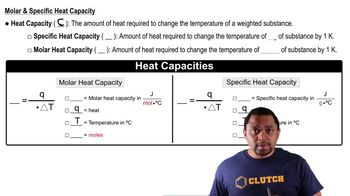
Use the heat equation to calculate the energy, in joules and calories, for each of the following (see TABLE 3.11):
c. lost when 15.0 g of ethanol, C2H6O, cools from 60.5 °C to −42.0 °C
1
views
 Verified step by step guidance
 02:19
02:19 02:19
02:19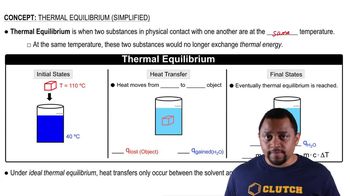 02:13
02:13Use the heat equation to calculate the energy, in joules and calories, for each of the following (see TABLE 3.11):
c. lost when 15.0 g of ethanol, C2H6O, cools from 60.5 °C to −42.0 °C
Identify each of the following changes of state as melting, freezing, sublimation, or deposition:
a. Dry ice in an ice-cream cart disappears.
Using the energy values for foods (see TABLE 3.7), determine each of the following (round off the answer for each food type to the tens place):
a. the total kilojoules in two tablespoons of crunchy peanut butter that contains 6 g of carbohydrate, 16 g of fat, and 7 g of protein
For dinner, Charles had one cup of clam chowder, which contains 16 g of carbohydrate, 12 g of fat, and 9 g of protein. How much energy, in kilocalories and kilojoules, is in the clam chowder? (Round off the answer for each food type to the tens place.)
A patient receives 3.2 L of intravenous (IV) glucose solution. If 100. mL of the solution contains 5.0 g of glucose (carbohydrate), how many kilocalories did the patient obtain from the glucose solution?
Identify each of the following changes of state as melting, freezing, sublimation, or deposition:
b. Snow on the ground turns to liquid water.