DNA footprint protection is a method that determines whether proteins bind to a specific sample of DNA and thus protect part of the DNA from random enzymatic cleavage by DNase I. A 400-bp segment of cloned DNA is thought to contain a promoter. The cloned DNA is analyzed by DNA footprinting to help determine if it has the capacity to act as a promoter sequence. The accompanying gel has two lanes, each containing the cloned 400-bp DNA fragment treated with DNase I to randomly cleave unprotected DNA. Lane 1 is cloned DNA that was mixed with RNA polymerase II and several TFII transcription factors before exposure to DNase I. Lane 2 contains cloned DNA that was exposed only to DNase I. RNA pol II and TFIIs were not mixed with that DNA before adding DNase I. Approximately what length is the DNA region protected by RNA pol II and TFIIs?

- Ch. 1 - The Molecular Basis of Heredity, Variation, and Evolution64
- Ch. 2 - Transmission Genetics144
- Ch. 3 - Cell Division and Chromosome Heredity81
- Ch. 4 - Gene Interaction87
- Ch. 5 - Genetic Linkage and Mapping in Eukaryotes103
- Ch. 6 - Genetic Analysis and Mapping in Bacteria and Bacteriophages73
- Ch. 7 - DNA Structure and Replication71
- Ch. 8 - Molecular Biology of Transcription and RNA Processing79
- Ch. 9 - The Molecular Biology of Translation110
- Ch. 10 - Eukaryotic Chromosome Abnormalities and Molecular Organization100
- Ch. 11 - Gene Mutation, DNA Repair, and Homologous Recombination86
- Ch. 12 - Regulation of Gene Expression in Bacteria and Bacteriophage90
- Ch. 13 - Regulation of Gene Expression in Eukaryotes38
- Ch. 14 - Analysis of Gene Function via Forward Genetics and Reverse Genetics72
- Ch. 15 - Recombinant DNA Technology and Its Applications69
- Ch. 16 - Genomics: Genetics from a Whole-Genome Perspective49
- Ch. 17 - Organelle Inheritance and the Evolution of Organelle Genomes27
- Ch. 18 - Developmental Genetics43
- Ch. 19 - Genetic Analysis of Quantitative Traits66
- Ch. 20 - Population Genetics and Evolution at the Population, Species, and Molecular Levels105
 Sanders 3rd EditionCh. 8 - Molecular Biology of Transcription and RNA ProcessingProblem 25d
The accompanying illustration shows a portion of a gene undergoing transcription. The template and coding strands for the gene are labeled, and a segment of DNA sequence is given.
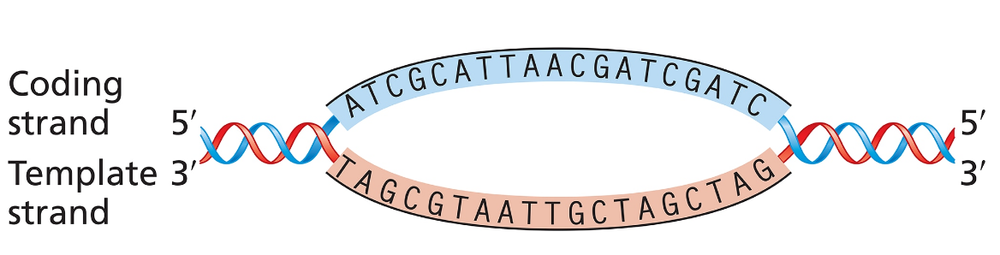
For this gene segment identify the direction in which the promoter [TIP 2] for this gene is located.
 Verified step by step guidance
Verified video answer for a similar problem:

Key Concepts
Gene Transcription
 09:16
09:16
Promoter Region
 00:30
00:30DNA Strand Orientation
 03:03
03:03The accompanying illustration shows a portion of a gene undergoing transcription. The template and coding strands for the gene are labeled, and a segment of DNA sequence is given.
For this gene segment indicate the direction in which RNA polymerase moves as it transcribes this gene.
The accompanying illustration shows a portion of a gene undergoing transcription. The template and coding strands for the gene are labeled, and a segment of DNA sequence is given.
For this gene segment, superimpose a drawing of RNA polymerase as it nears the end of transcription of the DNA sequence.
The accompanying illustration shows a portion of a gene undergoing transcription. The template and coding strands for the gene are labeled, and a segment of DNA sequence is given.
For this gene segment, write the polarity and sequence [TIP 1] of the RNA transcript from the DNA sequence given.
DNA footprint protection is a method that determines whether proteins bind to a specific sample of DNA and thus protect part of the DNA from random enzymatic cleavage by DNase I. A 400-bp segment of cloned DNA is thought to contain a promoter. The cloned DNA is analyzed by DNA footprinting to help determine if it has the capacity to act as a promoter sequence. The accompanying gel has two lanes, each containing the cloned 400-bp DNA fragment treated with DNase I to randomly cleave unprotected DNA. Lane 1 is cloned DNA that was mixed with RNA polymerase II and several TFII transcription factors before exposure to DNase I. Lane 2 contains cloned DNA that was exposed only to DNase I. RNA pol II and TFIIs were not mixed with that DNA before adding DNase I. Explain why this gel provides evidence that the cloned DNA may act as a promoter sequence.
DNA footprint protection is a method that determines whether proteins bind to a specific sample of DNA and thus protect part of the DNA from random enzymatic cleavage by DNase I. A 400-bp segment of cloned DNA is thought to contain a promoter. The cloned DNA is analyzed by DNA footprinting to help determine if it has the capacity to act as a promoter sequence. The accompanying gel has two lanes, each containing the cloned 400-bp DNA fragment treated with DNase I to randomly cleave unprotected DNA. Lane 1 is cloned DNA that was mixed with RNA polymerase II and several TFII transcription factors before exposure to DNase I. Lane 2 contains cloned DNA that was exposed only to DNase I. RNA pol II and TFIIs were not mixed with that DNA before adding DNase I. What additional genetic experiments would you suggest to verify that this region of cloned DNA contains a functional promoter?