
Textbook Question
The following dideoxy DNA sequencing gel is produced in a laboratory.
What is the double-stranded DNA sequence of this molecule? Label the polarity of each strand.

 Verified step by step guidance
 07:39
07:39
 04:12
04:12 06:36
06:36The following dideoxy DNA sequencing gel is produced in a laboratory.
What is the double-stranded DNA sequence of this molecule? Label the polarity of each strand.
A family consisting of a mother (I-1), a father (I-2), and three children (II-1, II-2, and II-3) are genotyped by PCR for a region of an autosome containing repeats of a 10-bp sequence. The mother carries 16 repeats on one chromosome and 21 on the homologous chromosome. The father carries repeat numbers of 18 and 26.
Identify all the possible genotypes of children of this couple by specifying PCR fragment lengths in each genotype.
A family consisting of a mother (I-1), a father (I-2), and three children (II-1, II-2, and II-3) are genotyped by PCR for a region of an autosome containing repeats of a 10-bp sequence. The mother carries 16 repeats on one chromosome and 21 on the homologous chromosome. The father carries repeat numbers of 18 and 26.
What genetic term best describes the pattern of inheritance of this DNA marker? Explain your choice.
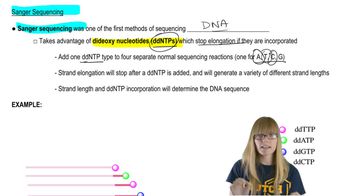
In a dideoxy DNA sequencing experiment, four separate reactions are carried out to provide the replicated material for DNA sequencing gels. Reaction products are usually run in gel lanes labeled A, T, C, and G.
Identify the nucleotides used in the dideoxy DNA sequencing reaction that produces molecules for the A lane of the sequencing gel.
In a dideoxy DNA sequencing experiment, four separate reactions are carried out to provide the replicated material for DNA sequencing gels. Reaction products are usually run in gel lanes labeled A, T, C, and G.
Why is incorporation of a dideoxynucleotide during DNA sequencing identified as a 'replication-terminating' event?
Using an illustration style and labeling, draw the electrophoresis gel containing dideoxy sequencing fragments for the DNA template strand 3'-AGACGATAGCAT-5'.