The wild-type color of horned beetles is black, although other colors are known. A black horned beetle from a pure-breeding strain is crossed to a pure-breeding green female beetle. All of their F₁ progeny are black. These F₁ are allowed to mate at random with one another, and 320 F₂ beetles are produced. The F₂ consists of 179 black, 81 green, and 60 brown. Use these data to explain the genetics of horned beetle color.

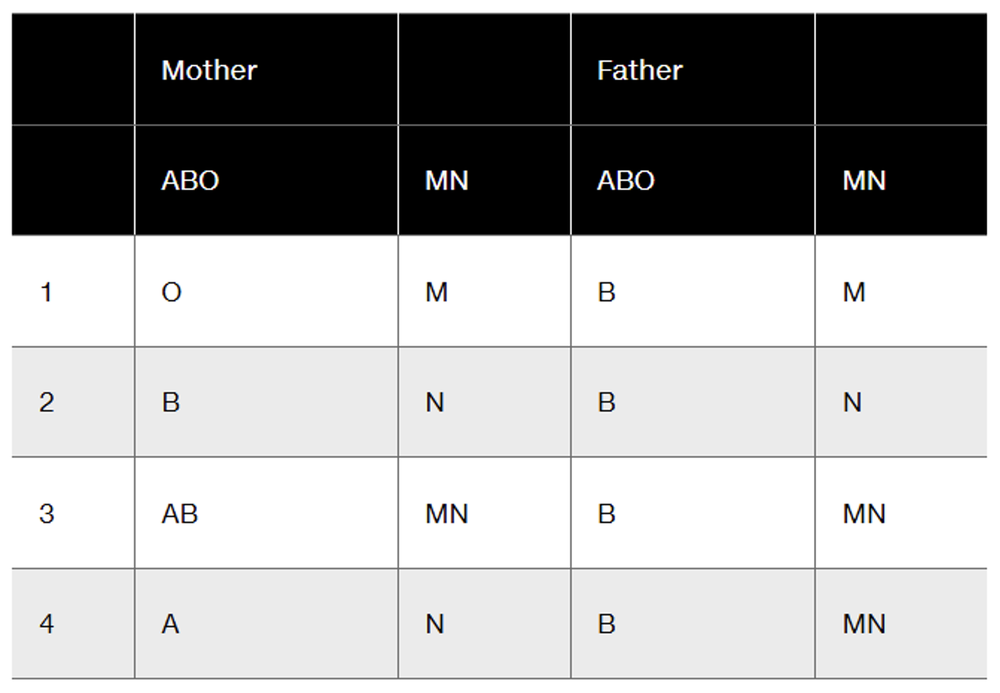
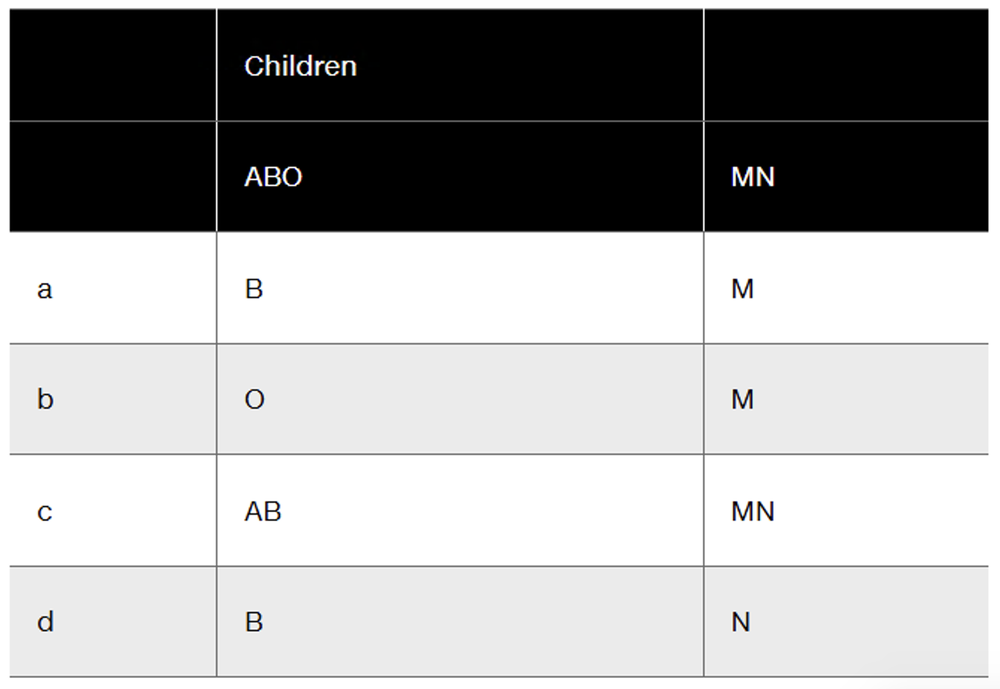
The ABO and MN blood groups are shown for four sets of parents (1 to 4) and four children (a to d). Recall that the ABO blood group has three alleles: IA, IB and i. The MN blood group has two codominant alleles, M and N. Using your knowledge of these genetic systems, match each child with every set of parents who might have conceived the child, and exclude any parental set that could not have conceived the child.


Verified step by step guidance
Verified video answer for a similar problem:
Key Concepts
ABO Blood Group Inheritance
MN Blood Group and Codominance
Genetic Compatibility and Exclusion
Two genes interact to produce various phenotypic ratios among F₂ progeny of a dihybrid cross. Design a different pathway explaining each of the F₂ ratios below, using hypothetical genes R and T and assuming that the dominant allele at each locus catalyzes a different reaction or performs an action leading to pigment production. The recessive allele at each locus is null (loss-of-function). Begin each pathway with a colorless precursor that produces a white or albino phenotype if it is unmodified. The ratios are for F₂ progeny produced by crossing wild-type F₁ organisms with the genotype RrTt.
9/16 dark blue : 6/16 light blue : 1/16 white
In a type of parakeet known as a "budgie," feather color is controlled by two genes. A yellow pigment is synthesized under the control of a dominant allele Y. Budgies that are homozygous for the recessive y allele do not synthesize yellow pigment. At an independently assorting gene, the dominant allele B directs synthesis of a blue pigment. Recessive homozygotes with the bb genotype do not produce blue pigment. Budgies that produce both yellow and blue pigments have green feathers; those that produce only yellow pigment or only blue pigment have yellow or blue feathers, respectively; and budgies that produce neither pigment are white (albino).
c. What are the genotype(s) and phenotype(s) of the F₁ progeny of the cross described in part (b)?
Two genes interact to produce various phenotypic ratios among F₂ progeny of a dihybrid cross. Design a different pathway explaining each of the F₂ ratios below, using hypothetical genes R and T and assuming that the dominant allele at each locus catalyzes a different reaction or performs an action leading to pigment production. The recessive allele at each locus is null (loss-of-function). Begin each pathway with a colorless precursor that produces a white or albino phenotype if it is unmodified. The ratios are for F₂ progeny produced by crossing wild-type F₁ organisms with the genotype RrTt.
12/16 white : 3/16 green : 1/16 yellow
In a type of parakeet known as a "budgie," feather color is controlled by two genes. A yellow pigment is synthesized under the control of a dominant allele Y. Budgies that are homozygous for the recessive y allele do not synthesize yellow pigment. At an independently assorting gene, the dominant allele B directs synthesis of a blue pigment. Recessive homozygotes with the bb genotype do not produce blue pigment. Budgies that produce both yellow and blue pigments have green feathers; those that produce only yellow pigment or only blue pigment have yellow or blue feathers, respectively; and budgies that produce neither pigment are white (albino).
d. If F₁ males and females are mated, what phenotypes are expected in the F₂, and in what proportions?
In a type of parakeet known as a "budgie," feather color is controlled by two genes. A yellow pigment is synthesized under the control of a dominant allele Y. Budgies that are homozygous for the recessive y allele do not synthesize yellow pigment. At an independently assorting gene, the dominant allele B directs synthesis of a blue pigment. Recessive homozygotes with the bb genotype do not produce blue pigment. Budgies that produce both yellow and blue pigments have green feathers; those that produce only yellow pigment or only blue pigment have yellow or blue feathers, respectively; and budgies that produce neither pigment are white (albino).
e. The cross of a green budgie and a yellow budgie produces offspring that are 12 green, 4 blue, 13 yellow, and 3 albino. What are the genotypes of the parents?
