
Textbook Question
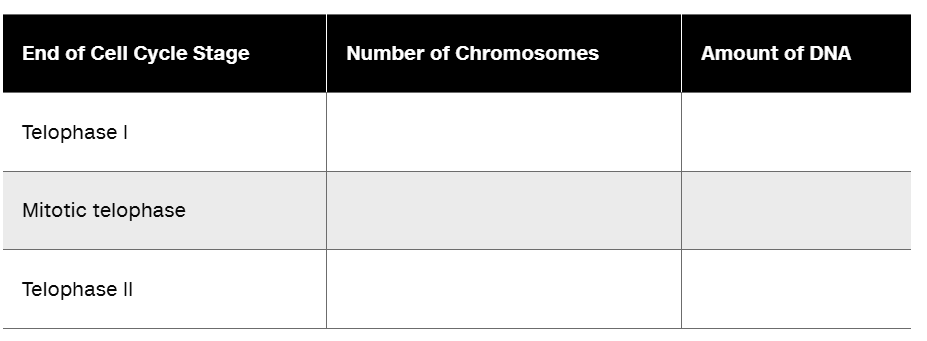
The diploid number of the hypothetical animal Geneticus introductus is 2n = 36. Each diploid nucleus contains 3 ng of DNA in G₁.
What amount of DNA is contained in each nucleus at the end of the S phase?

 Verified step by step guidance
 27:36
27:36
 04:29
04:29 11:59
11:59The diploid number of the hypothetical animal Geneticus introductus is 2n = 36. Each diploid nucleus contains 3 ng of DNA in G₁.
What amount of DNA is contained in each nucleus at the end of the S phase?
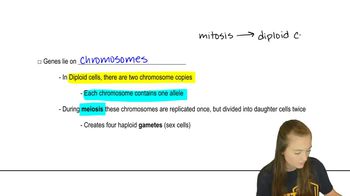
Explain how the behavior of homologous chromosomes in meiosis parallels Mendel's law of segregation for autosomal alleles D and d. During which stage of M phase do these two alleles segregate from one another?
Cohesion between sister chromatids, as well as tension created by the pull of kinetochore microtubules, is essential to ensure efficient separation of chromatids at mitotic anaphase or in meiotic anaphase II. Explain why sister chromatid cohesion is important, and discuss the role of the proteins cohesin and separase in sister chromatid separation.
The diploid number of the hypothetical animal Geneticus introductus is 2n = 36. Each diploid nucleus contains 3 ng of DNA in G₁.
Explain why a somatic cell of Geneticus introductus has the same number of chromosomes and the same amount of DNA at the beginning of mitotic prophase as one of these cells does at the beginning of prophase I of meiosis.
An organism has alleles R₁ and R₂ on one pair of homologous chromosomes, and it has alleles T₁ and T₂ on another pair. Diagram these pairs of homologs at the end of metaphase I, the end of telophase I, and the end of telophase II, and show how meiosis in this organism produces gametes in expected Mendelian proportions. Assume no crossover between homologous chromosomes.
Suppose crossover occurs between the homologous chromosomes in the previous problem. At what stage of M phase do alleles D and d segregate?