Ch. 3 - Cell Division and Chromosome Heredity
Sanders - Genetic Analysis: An Integrated Approach 3rd Edition
Sanders3rd EditionGenetic Analysis: An Integrated ApproachISBN: 9780135564172Not the one you use?Change textbook
Chapter 3, Problem 25a

Lesch–Nyhan syndrome (OMIM 300322) is a rare X-linked recessive disorder that produces severe mental retardation, spastic cerebral palsy, and self-mutilation.


What is the probability that the first son of a woman whose brother has Lesch–Nyhan syndrome will be affected?

Verified step by step guidance
1
Understand the inheritance pattern: Lesch–Nyhan syndrome is an X-linked recessive disorder. This means the gene responsible for the condition is located on the X chromosome, and males (XY) are more likely to be affected because they have only one X chromosome.
Determine the genetic status of the woman: Since her brother has Lesch–Nyhan syndrome, her mother must be a carrier (heterozygous for the mutation). The woman has a 50% chance of inheriting the affected X chromosome from her mother, making her a carrier.
Consider the genetic contribution to the son: If the woman is a carrier, there is a 50% chance she will pass on the affected X chromosome to her child. Sons inherit their X chromosome from their mother and their Y chromosome from their father.
Combine probabilities: The probability that the woman is a carrier (50%) and the probability that she passes on the affected X chromosome to her son (50%) must be multiplied to determine the overall probability that her son will be affected.
Express the final probability: Multiply the probabilities from the previous step (0.5 × 0.5) to calculate the likelihood that her first son will inherit Lesch–Nyhan syndrome. This step provides the final probability but does not calculate the numerical result explicitly.

Verified video answer for a similar problem:

This video solution was recommended by our tutors as helpful for the problem above.
Video duration:
1m
Was this helpful?

Key Concepts

Here are the essential concepts you must grasp in order to answer the question correctly.

X-linked Recessive Inheritance

Lesch–Nyhan syndrome is an X-linked recessive disorder, meaning the gene responsible for the condition is located on the X chromosome. Males, having one X and one Y chromosome, are more likely to express the disorder if they inherit the affected X. Females, with two X chromosomes, can be carriers if they have one affected X but typically do not show symptoms unless both X chromosomes are affected.
Recommended video:
Guided course
09:30
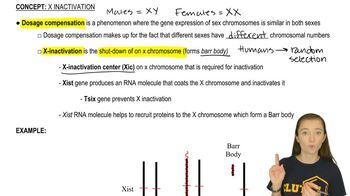
X-Inactivation

Carrier Status

In the context of X-linked disorders, a carrier female has one normal X chromosome and one affected X chromosome. If her brother has Lesch–Nyhan syndrome, it indicates that he inherited the affected X from their mother, making her a carrier. The probability of her passing the affected X to her son is 50%, as sons inherit their X chromosome from their mother.
Recommended video:
Guided course
10:56
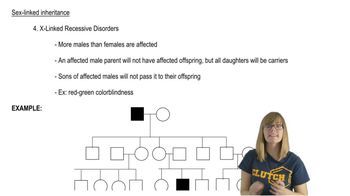
Sex-Linked Pedigrees

Punnett Square

A Punnett square is a tool used in genetics to predict the probability of offspring inheriting particular traits from their parents. In this case, it can be used to visualize the potential genetic combinations between a carrier mother (X^H X) and a normal father (X Y). This helps in determining the likelihood of their son inheriting the affected X chromosome and thus being affected by Lesch–Nyhan syndrome.
Recommended video:
Guided course
18:27
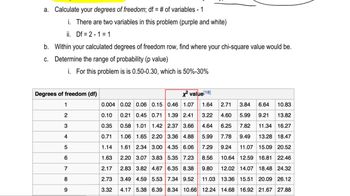
Chi Square Analysis
Related Practice
Textbook Question

In a species of fish, a black spot on the dorsal fin is observed in males and females. A fish breeder carries out a pair of reciprocal crosses and observes the following results.


Why does this evidence support the hypothesis that a black spot is sex linked?

1
views
Textbook Question

In humans, SRY is located near a pseudoautosomal region (PAR) of the Y chromosome, a region of homology between the X and Y chromosomes that allows them to synapse during meiosis in males and is a region of crossover between the chromosomes. The diagram below shows SRY in relation to the pseudoautosomal region.

About 1 in every 25,000 newborn infants is born with sex reversal; the infant is either an apparent male but with two X chromosomes or an apparent female but with an X and a Y chromosome. Explain the origin of sex reversal in human males and females involving the SRY gene. (Hint: See Experimental Insight 3.1 for a clue about the mutational mechanism.) 

3
views
Textbook Question

In fruit flies, yellow body (y) is recessive to gray body , and the trait of body color is inherited on the X chromosome. Vestigial wing (v) is recessive to full-sized wing (v⁺), and the trait has autosomal inheritance. A cross of a male with yellow body and full wings to a female with gray body and full wings is made. Based on an analysis of the progeny of the cross shown below, determine the genotypes of parental and progeny flies.

[Table below appears at this point containing crosses and results]

Textbook Question

Lesch–Nyhan syndrome (OMIM 300322) is a rare X-linked recessive disorder that produces severe mental retardation, spastic cerebral palsy, and self-mutilation.


What is the probability that the first son of a man whose brother has Lesch–Nyhan syndrome will be affected?

Textbook Question

Lesch–Nyhan syndrome (OMIM 300322) is a rare X-linked recessive disorder that produces severe mental retardation, spastic cerebral palsy, and self-mutilation.


If the first son of the woman described in (a) is affected, what is the probability that her second son is affected?

2
views
Textbook Question

In a species of fish, a black spot on the dorsal fin is observed in males and females. A fish breeder carries out a pair of reciprocal crosses and observes the following results.

Identify which sex is heterogametic. Give genotypes for the parents in each cross, and explain the progeny proportions in each cross.