Sanders 3rd Edition
Ch. 20 - Population Genetics and Evolution at the Population, Species, and Molecular Levels
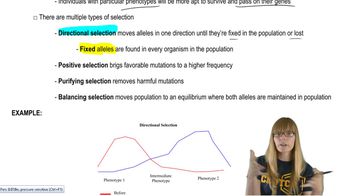
Problem 37The human melanocortin 1 receptor gene (MC1R) plays a major role in producing eumelanin, a black-brown pigment that helps determine hair color and skin color. Jonathan Rees and several colleagues (J. L. Rees et al., Am. J. Human Genet. 66(2000): 1351–1361) studied multiple MC1R alleles in African and European populations. Although this research found several MC1R alleles in African populations, MC1R alleles that decrease the production of eumelanin were rare. In contrast, several alleles decreasing eumelanin production were found in European populations. How can these results be explained by natural selection?
Verified step by step guidance
Verified video answer for a similar problem:
Key Concepts
Natural Selection
Eumelanin and Phenotypic Variation
Population Genetics
Draw a separate hypothetical pedigree identifying the inbred individuals and the inbreeding pathways for each of the following inbreeding coefficients:
F=2(1/2)⁷
Draw a separate hypothetical pedigree identifying the inbred individuals and the inbreeding pathways for each of the following inbreeding coefficients:
F=4(1/2)⁸
New allopolyploid plant species can arise by hybridization between two species. If hybridization occurs between a diploid plant species with 2n = 14 and a second diploid species with 2n = 22, the new allopolyploid would have 36 chromosomes. What type of isolation mechanism is most likely to prevent hybridization between the allopolyploid and the diploid species?
New allopolyploid plant species can arise by hybridization between two species. If hybridization occurs between a diploid plant species with 2n = 14 and a second diploid species with 2n = 22, the new allopolyploid would have 36 chromosomes. Is it likely that sexual reproduction between the allopolyploid species and either of its diploid ancestors would yield fertile progeny? Why or why not?
Draw a separate hypothetical pedigree identifying the inbred individuals and the inbreeding pathways for each of the following inbreeding coefficients:
F=2(1/2)⁵