
Textbook Question
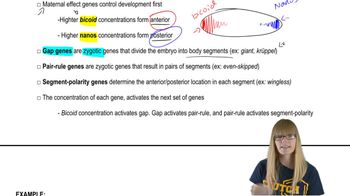
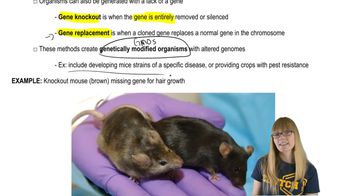
Why do loss-of-function mutations in Hox genes usually result in embryo lethality, whereas gain-of-function mutants can be viable? Why are flies homozygous for the recessive loss-of-function alleles and viable?

 Verified step by step guidance
 11:19
11:19
 09:12
09:12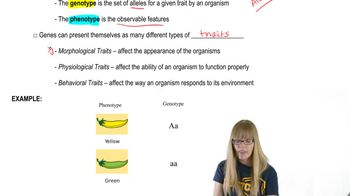 03:45
03:45Why do loss-of-function mutations in Hox genes usually result in embryo lethality, whereas gain-of-function mutants can be viable? Why are flies homozygous for the recessive loss-of-function alleles and viable?
Actinomycin D is a drug that inhibits the activity of RNA polymerase II. In the presence of actinomycin D, early development in many vertebrate species, such as frogs, can proceed past the formation of a blastula, a hollow ball of cells that forms after early cleavage divisions, but development ceases before gastrulation (the stage at which cell layers are established). What does this tell you about maternal versus zygotic gene activity in early frog development?
What is the difference between a parasegment and a segment in Drosophila development? Why do developmental biologists think of parasegments as the subdivisions that are produced during the development of flies?
Consider the even-skipped regulatory sequences in Figure 18.9.
Explain what you expect to see happen to even-skipped stripe 2 if it is expressed in a Krüppel mutant background. What about a hunchback mutant background? A giant mutant background? A bicoid mutant background?
Ablation of the anchor cell in wild-type C. elegans results in a vulva-less phenotype.
What about if the anchor cell is ablated in a let-23 gain-of-function mutant?
Ablation of the anchor cell in wild-type C. elegans results in a vulva-less phenotype.
What phenotype is to be expected if the anchor cell is ablated in a let-23 loss-of-function mutant?