Textbook Question
How could antisense RNA be used as an antibiotic? What types of genes would you target using this scheme?

 Sanders 3rd EditionCh. 12 - Regulation of Gene Expression in Bacteria and BacteriophageProblem 30b
 Verified step by step guidance
 04:27
04:27
 03:38
03:38 09:16
09:16How could antisense RNA be used as an antibiotic? What types of genes would you target using this scheme?
The function of tRNA synthetases is to attach amino acids to tRNAs. Suppose the tRNA synthetase responsible for attaching tryptophan to tRNA is mutated in a bacterial strain, with the result that the tRNA synthetase functions at about 15% of the efficiency of the wild-type tRNA synthetase.
How would this mutation affect attenuation of the tryptophan operon? Explain your answer.
The bacterial insertion sequence IS10 uses antisense RNA to regulate translation of the mRNA that produces the enzyme transposase, which is required for insertion sequence transposition. Transcription of the antisense RNA gene is controlled by POUT, which is more than 10 times more efficient at transcription than the PIN promoter, which controls transposase gene transcription.
If a mutation of PIN eliminates its ability to function in transcription, what is the likely effect on the transposition of IS10?
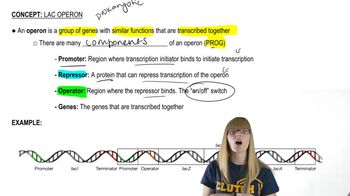
For an E. coli strain with the lac operon genotype I⁺ P⁺ O⁺ Z⁺ Y⁺, identify the level of transcription of the operon genes in each growth medium listed. Specify transcription as 'none,' 'basal,' or 'activated' for each medium, and provide an explanation to justify your answer.
Growth medium contains lactose but no glucose.
For an E. coli strain with the lac operon genotype I⁺ P⁺ O⁺ Z⁺ Y⁺, identify the level of transcription of the operon genes in each growth medium listed. Specify transcription as 'none,' 'basal,' or 'activated' for each medium, and provide an explanation to justify your answer.
Growth medium contains lactose and glucose.
The bacterial insertion sequence IS10 uses antisense RNA to regulate translation of the mRNA that produces the enzyme transposase, which is required for insertion sequence transposition. Transcription of the antisense RNA gene is controlled by POUT, which is more than 10 times more efficient at transcription than the PIN promoter, which controls transposase gene transcription.
If a mutation reduced the transcriptional efficiency of POUT so as to be equal to that of PIN, what is the likely effect on the transposition of IS10?