
Following the spill of a mixture of chemicals into a small pond, bacteria from the pond are tested and show an unusually high rate of mutation. A number of mutant cultures are grown from mutant colonies and treated with known mutagens to study the rate of reversion. Most of the mutant cultures show a significantly higher reversion rate when exposed to base analogs such as proflavin and 2-aminopurine. What does this suggest about the nature of the chemicals in the spill?

Sanders 3rd Edition
Ch. 11 - Gene Mutation, DNA Repair, and Homologous Recombination
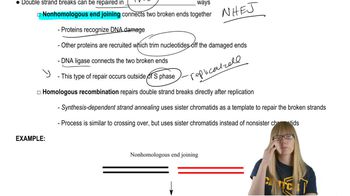
Problem 25Briefly compare the production of DNA double-strand breaks in bacteria versus the double-strand breaks that precede homologous recombination.
Verified step by step guidance
Verified video answer for a similar problem:
Key Concepts
DNA Double-Strand Breaks (DSBs)
Homologous Recombination
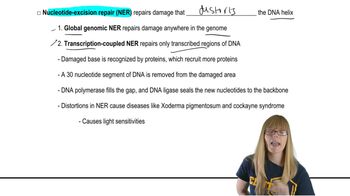
Bacterial DNA Repair Mechanisms
In an Ames test using his⁻ Salmonella bacteria a researcher determines that adding a test compound plus the S9 extract produces a large number of his⁺ revertants but mixing the his⁻ strain plus the test compound without adding S9 does not produce an elevated number of his⁺ revertants.
What is the reason for the different experimental results described?
Many human genes are known to have homologs in the mouse genome. One approach to investigating human hereditary disease is to produce mutations of the mouse homologs of human genes by methods that can precisely target specific nucleotides for mutation.
Despite the homologies that exist between human and mouse genes, some attempts to study human hereditary disease processes by inducing mutations in mouse genes indicate there is little to be learned about human disease in this way. In general terms, describe how and why the study of mouse gene mutations might fail to produce useful information about human disease processes.