Textbook Question
A fragment of a wild-type polypeptide is sequenced for seven amino acids. The same polypeptide region is sequenced in four mutants.
Identify the mutation that produces each mutant polypeptide.

 Sanders 3rd EditionCh. 11 - Gene Mutation, DNA Repair, and Homologous RecombinationProblem 29e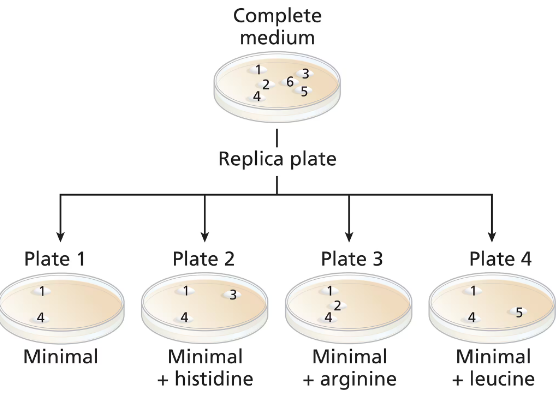
 Verified step by step guidance
 06:36
06:36
 10:48
10:48 11:19
11:19A fragment of a wild-type polypeptide is sequenced for seven amino acids. The same polypeptide region is sequenced in four mutants.
Identify the mutation that produces each mutant polypeptide.
A wild-type culture of haploid yeast is exposed to ethyl methanesulfonate (EMS). Yeast cells are plated on a complete medium, and 6 colonies (colonies numbered 1 to 6) are transferred to a new complete medium plate for further study. Four replica plates are made from the complete medium plate to plates containing minimal medium or minimal medium plus one amino acid (replica plates numbered 1 to 4) with the following results:
For colonies 1, 3, and 5, write '+' for the wild-type synthesis and '−' for the mutant synthesis of histidine and leucine.
A wild-type culture of haploid yeast is exposed to ethyl methanesulfonate (EMS). Yeast cells are plated on a complete medium, and 6 colonies (colonies numbered 1 to 6) are transferred to a new complete medium plate for further study. Four replica plates are made from the complete medium plate to plates containing minimal medium or minimal medium plus one amino acid (replica plates numbered 1 to 4) with the following results:
Identify any colonies that are his⁻, arg⁻, leu⁻.
A fragment of a wild-type polypeptide is sequenced for seven amino acids. The same polypeptide region is sequenced in four mutants.
Use the available information to characterize each mutant.
A fragment of a wild-type polypeptide is sequenced for seven amino acids. The same polypeptide region is sequenced in four mutants.
Determine the wild-type mRNA sequence.
A wild-type culture of haploid yeast is exposed to ethyl methanesulfonate (EMS). Yeast cells are plated on a complete medium, and 6 colonies (colonies numbered 1 to 6) are transferred to a new complete medium plate for further study. Four replica plates are made from the complete medium plate to plates containing minimal medium or minimal medium plus one amino acid (replica plates numbered 1 to 4) with the following results:
Identify the colonies that are auxotrophic (mutant). What growth information leads to your answer?