A plant breeder would like to develop a seedless variety of cucumber from two existing lines. Line A is a tetraploid line, and line B is a diploid line. Describe the breeding strategy that will produce a seedless line, and support your strategy by describing the results of crosses.

Sanders 3rd Edition
Ch. 10 - Eukaryotic Chromosome Abnormalities and Molecular Organization
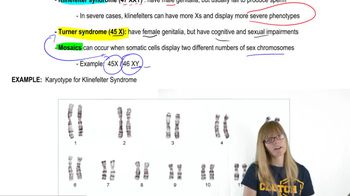
Problem 19In humans that are XX/XO mosaics, the phenotype is highly variable, ranging from females who have classic Turner syndrome symptoms to females who are essentially normal. Likewise, XY/XO mosaics have phenotypes that range from Turner syndrome females to essentially normal males. How can the wide range of phenotypes be explained for these sex-chromosome mosaics?
Verified step by step guidance
Verified video answer for a similar problem:
Key Concepts
Mosaicism
Turner Syndrome
Phenotypic Variability
The accompanying chromosome diagram represents a eukaryotic chromosome prepared with Giemsa stain. Indicate the heterochromatic and euchromatic regions of the chromosome, and label the chromosome's centromeric and telomeric regions.
Are you more likely to find the DNA sequence encoding the digestive enzyme amylase in a heterochromatic, euchromatic, centromeric, or telomeric region? Explain your reasoning.
Two experimental varieties of strawberry are produced by crossing a hexaploid line that contains 48 chromosomes and a tetraploid line that contains 32 chromosomes. Experimental variety 1 contains 40 chromosomes, and experimental variety 2 contains 56 chromosomes.
Do you expect both experimental lines to be fertile? Why or why not?
In Drosophila, seven partial deletions (1 to 7) shown as gaps in the following diagram have been mapped on a chromosome. This region of the chromosome contains genes that express seven recessive mutant phenotypes, identified in the following table as a through g. A researcher wants to determine the location and order of genes on the chromosome, so he sets up a series of crosses in which flies homozygous for a mutant allele are crossed with flies homozygous for a partial deletion. The progeny are scored to determine whether they have the mutant phenotype ('m' in the table) or the wild-type phenotype ('+' in the table). Use the partial deletion map and the table of progeny phenotypes to determine the order of genes on the chromosome.
A survey of organisms living deep in the ocean reveals two new species whose DNA is isolated for analysis. DNA samples from both species are treated to remove nonhistone proteins. Each DNA sample is then treated with DNase I that cuts DNA not protected by histone proteins but is unable to cut DNA bound by histone proteins. Following DNase I treatment, DNA samples are subjected to gel electrophoresis, and the gels are stained to visualize all DNA bands in the gel. The staining patterns of DNA bands from each species are shown in the figure. The number of base pairs in small DNA fragments is shown at the left of the gel. Interpret the gel results in terms of chromatin organization and the spacing of nucleosomes in the chromatin of each species.
Histone protein H4 isolated from pea plants and cow thymus glands contains 102 amino acids in both cases. A total of 100 of the amino acids are identical between the two species. Give an evolutionary explanation for this strong amino acid sequence identity based on what you know about the functions of histones and nucleosomes.