It has been suggested that any male-determining genes contained on the Y chromosome in humans cannot be located in the limited region that synapses with the X chromosome during meiosis. What might be the outcome if such genes were located in this region?

An attached-X female fly, XXY, expresses the recessive X-linked white-eye mutation. It is crossed to a male fly that expresses the X-linked recessive miniature-wing mutation. Determine the outcome of this cross in terms of sex, eye color, and wing size of the offspring.
Verified step by step guidance
Verified video answer for a similar problem:
Key Concepts
X-linked Inheritance
Attached-X Chromosome Configuration
Phenotypic Expression of Recessive Mutations
Assume that on rare occasions the attached X chromosomes in female gametes become unattached. Based on the parental phenotypes in Problem 12, what outcomes in the F₁ generation would indicate that this has occurred during female meiosis?
An insect species is discovered in which the heterogametic sex is unknown. An X-linked recessive mutation for reduced wing (rw) is discovered. Contrast the F1 and F2 generations from a cross between a female with reduced wings and a male with normal-sized wings when the female is the heterogametic sex.
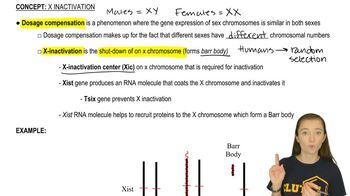
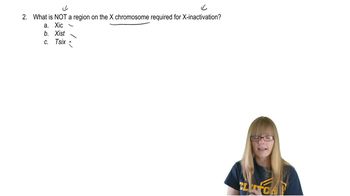
What is a Barr body, and where is it found in a cell?
When cows have twin calves of unlike sex (fraternal twins), the female twin is usually sterile and has masculinized reproductive organs. This calf is referred to as a freemartin. In cows, twins may share a common placenta and thus fetal circulation. Predict why a freemartin develops.
An insect species is discovered in which the heterogametic sex is unknown. An X-linked recessive mutation for reduced wing (rw) is discovered. Contrast the F1 and F2 generations from a cross between a female with reduced wings and a male with normal-sized wings when the male is the heterogametic sex.
