
Albinism, caused by a mutational disruption in melanin (skin pigment) production, has been observed in many species, including humans. In 1991, and again recently in 2017, the only documented observations of an albino humpback whale (named 'Migaloo') were observed near New South Wales. Recently, Polanowski and coworkers (Polanowski, A., S. Robinson-Laverick, and D. Paton. (2012). Journal of Heredity 103:130–133) studied the genetics of humpback whales from the east coast of Australia, including Migaloo. Assuming that Migaloo's albinism is caused by a rare recessive gene, what would be the likelihood of the establishment of a natural robust subpopulation of albino white humpback whales in this population?

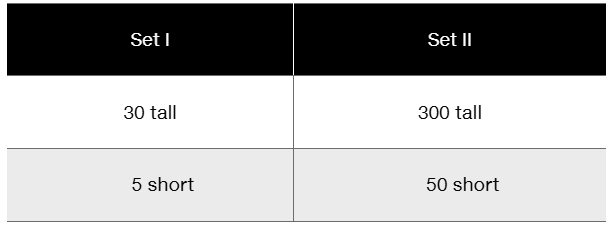
To assess Mendel's law of segregation using tomatoes, a true-breeding tall variety (SS) is crossed with a true-breeding short variety (ss). The heterozygous F₁ tall plants (Ss) were crossed to produce two sets of F₂ data, as follows.

From the above analysis, what can you conclude about the importance of generating large datasets in experimental conditions?
Verified step by step guidance
Verified video answer for a similar problem:
Key Concepts
Mendel's Law of Segregation
Sample Size and Statistical Reliability
Phenotypic Ratios in Genetic Crosses
Albinism, caused by a mutational disruption in melanin (skin pigment) production, has been observed in many species, including humans. In 1991, and again recently in 2017, the only documented observations of an albino humpback whale (named 'Migaloo') were observed near New South Wales. Recently, Polanowski and coworkers (Polanowski, A., S. Robinson-Laverick, and D. Paton. (2012). Journal of Heredity 103:130–133) studied the genetics of humpback whales from the east coast of Australia, including Migaloo. What data would be helpful in determining the answer to part (a)?
To assess Mendel's law of segregation using tomatoes, a true-breeding tall variety (SS) is crossed with a true-breeding short variety (ss). The heterozygous F₁ tall plants (Ss) were crossed to produce two sets of F₂ data, as follows.
Using the X² test, analyze the results for both datasets. Calculate X² values and estimate the p values in both cases.
Albinism, caused by a mutational disruption in melanin (skin pigment) production, has been observed in many species, including humans. In 1991, and again recently in 2017, the only documented observations of an albino humpback whale (named 'Migaloo') were observed near New South Wales. Recently, Polanowski and coworkers (Polanowski, A., S. Robinson-Laverick, and D. Paton. (2012). Journal of Heredity 103:130–133) studied the genetics of humpback whales from the east coast of Australia, including Migaloo. Do you think that Migaloo's albinism is more likely caused by a dominant or recessive mutation? Explain your reasoning.
The wild-type (normal) fruit fly, Drosophila melanogaster, has straight wings and long bristles. Mutant strains have been isolated that have either curled wings or short bristles. The genes representing these two mutant traits are located on separate chromosomes. Carefully examine the data from the following five crosses.
Identify each mutation as either dominant or recessive. In each case, indicate which crosses support your answer.
The wild-type (normal) fruit fly, Drosophila melanogaster, has straight wings and long bristles. Mutant strains have been isolated that have either curled wings or short bristles. The genes representing these two mutant traits are located on separate chromosomes. Carefully examine the data from the following five crosses.
Assign gene symbols and, for each cross, determine the genotypes of the parents.
