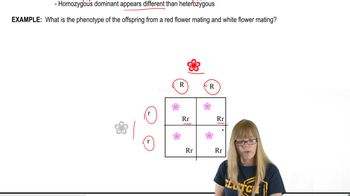
Mendel crossed peas having green seeds with peas having yellow seeds. The F₁ generation produced only yellow seeds. In the F₂, the progeny consisted of 6022 plants with yellow seeds and 2001 plants with green seeds. Of the F₂ yellow-seeded plants, 519 were self-fertilized with the following results: 166 bred true for yellow and 353 produced an F₃ ratio of 3/4 yellow: 1/4 green. Explain these results by diagramming the crosses.

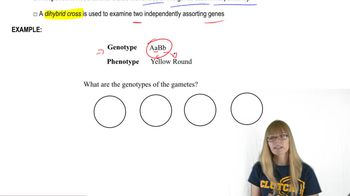
Mendel crossed peas having round green seeds with peas having wrinkled yellow seeds. All F₁ plants had seeds that were round and yellow. Predict the results of testcrossing these F₁ plants.
Verified step by step guidance
Verified video answer for a similar problem:
Key Concepts
Mendelian Inheritance and Dominance
Testcross
Independent Assortment and Dihybrid Cross
In assessing data that fell into two phenotypic classes, a geneticist observed values of 250:150. She decided to perform a ² analysis by using the following two different null hypotheses:
(a) the data fit a 3:1 ratio, and
(b) the data fit a 1:1 ratio.
Calculate the ² values for each hypothesis. What can be concluded about each hypothesis?
Thalassemia is an inherited anemic disorder in humans. Affected individuals exhibit either a minor anemia or a major anemia. Assuming that only a single gene pair and two alleles are involved in the inheritance of these conditions, is thalassemia a dominant or recessive disorder?
The following are F₂ results of two of Mendel's monohybrid crosses.
For each cross, state a null hypothesis to be tested using x² analysis. Calculate the x² value and determine the p value for both. Interpret the p-values. Can the deviation in each case be attributed to chance or not? Which of the two crosses shows a greater amount of deviation?
How many different types of gametes can be formed by individuals of the following genotypes:
(a) AaBb
(b) AaBB
(c) AaBbCc
(d) AaBBcc
(e) AaBbcc
(f) AaBbCcDdEe
What are the gametes in each case?
In a study of black guinea pigs and white guinea pigs, 100 black animals were crossed with 100 white animals, and each cross was carried to an F₂ generation. In 94 of the crosses, all the F₁ offspring were black and an F₂ ratio of 3 black:1 white was obtained. In the other 6 cases, half of the F₁ animals were black and the other half were white. Why? Predict the results of crossing the black and white F₁ guinea pigs from the 6 exceptional cases.
