What evidence did Watson and Crick have at their disposal in 1953? What was their approach in arriving at the structure of DNA?
Ch. 9 - DNA Structure and Analysis
Chapter 9, Problem 14
Describe the various characteristics of the Watson–Crick double-helix model for DNA.
Verified step by step guidance1
Start by explaining that the Watson–Crick model describes DNA as a double helix, which means it consists of two strands twisted around each other in a spiral shape.
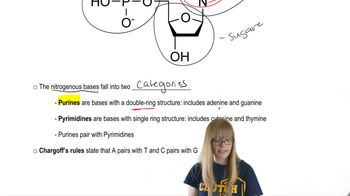
Describe the backbone of each DNA strand, which is made up of alternating sugar (deoxyribose) and phosphate groups, connected by phosphodiester bonds.
Explain that the two strands run in opposite directions, meaning they are antiparallel; one strand runs 5' to 3' and the other runs 3' to 5'.
Discuss the base pairing rules: adenine (A) pairs with thymine (T) via two hydrogen bonds, and guanine (G) pairs with cytosine (C) via three hydrogen bonds, which stabilizes the double helix.
Mention that the bases are located on the inside of the helix, stacked like steps of a spiral staircase, while the sugar-phosphate backbones form the outside, and that the helix has a major and minor groove important for protein binding.

Verified video answer for a similar problem:
This video solution was recommended by our tutors as helpful for the problem above.
Video duration:
1mWas this helpful?
Key Concepts
Here are the essential concepts you must grasp in order to answer the question correctly.
Structure of the Double Helix
The Watson–Crick model describes DNA as two antiparallel strands twisted into a right-handed double helix. Each strand consists of a sugar-phosphate backbone with nitrogenous bases projecting inward, forming the helical shape essential for DNA's stability and function.
Recommended video:
Guided course
DNA Structure
Base Pairing Rules
In the double helix, nitrogenous bases pair specifically: adenine (A) pairs with thymine (T) via two hydrogen bonds, and guanine (G) pairs with cytosine (C) via three hydrogen bonds. This complementary base pairing ensures accurate DNA replication and genetic information storage.
Recommended video:
Guided course
Base Distortions
Antiparallel Orientation
The two DNA strands run in opposite directions, one 5' to 3' and the other 3' to 5'. This antiparallel arrangement is crucial for enzymatic processes like replication and transcription, allowing enzymes to read and synthesize DNA efficiently.
Recommended video:
Guided course
Proteins
Related Practice
Textbook Question
Textbook Question
How do covalent bonds differ from hydrogen bonds? Define base complementarity.
Textbook Question
Adenine may also be named 6-amino purine. How would you name the other four nitrogenous bases, using this alternative system? (O is indicated by 'oxy-,' and CH₃ by 'methyl.')
Textbook Question
What might Watson and Crick have concluded had Chargaff's data from a single source indicated the following?
Why would this conclusion be contradictory to Wilkins's and Franklin's data?
Textbook Question
How are the carbon and nitrogen atoms of the sugars, purines, and pyrimidines numbered?
Textbook Question
Draw the chemical structure of a dinucleotide composed of A and G. Opposite this structure, draw the dinucleotide composed of T and C in an antiparallel (or upside-down) fashion. Form the possible hydrogen bonds.