How do we know that bacteria undergo genetic recombination, allowing the transfer of genes from one organism to another?
Verified step by step guidance
1
Understand the concept of genetic recombination in bacteria, which refers to the process where genetic material is exchanged between different bacterial cells, leading to new combinations of genes.
Examine experimental evidence such as the classic experiments by Frederick Griffith, who demonstrated transformation by showing that non-virulent bacteria could acquire virulence traits from dead virulent bacteria, indicating gene transfer.
Consider the process of conjugation, where direct cell-to-cell contact allows the transfer of plasmids or chromosomal DNA between bacteria, providing physical evidence of gene exchange.
Look at transduction, where bacteriophages (viruses that infect bacteria) accidentally transfer bacterial DNA from one cell to another, further supporting the occurrence of genetic recombination.
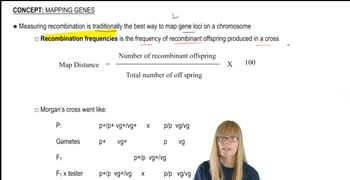
Analyze genetic mapping experiments in bacteria, where recombination frequencies between genes are measured, confirming that gene transfer and recombination occur and can be quantified.
Verified video answer for a similar problem:
This video solution was recommended by our tutors as helpful for the problem above.
Video duration:
1m
Play a video:
0 Comments
Was this helpful?
Key Concepts
Here are the essential concepts you must grasp in order to answer the question correctly.
Genetic Recombination in Bacteria
Genetic recombination in bacteria refers to the process where DNA is exchanged between different bacterial cells, leading to new genetic combinations. This process increases genetic diversity and can occur through mechanisms like transformation, transduction, and conjugation.
Bacteria transfer genes via three main mechanisms: transformation (uptake of free DNA from the environment), transduction (gene transfer mediated by bacteriophages), and conjugation (direct transfer of DNA through cell-to-cell contact). Each mechanism demonstrates how genetic material moves between organisms.
Experiments such as the Griffith experiment and the Lederberg and Tatum conjugation studies provide evidence for bacterial genetic recombination. These experiments showed that bacteria can acquire new traits by receiving genetic material from other cells, confirming gene transfer and recombination.