
Textbook Question
Based on our discussion of the potential inaccuracy of mapping, would you revise your answer to Problem 22? If so, how?
4
views
 Verified step by step guidance
 00:52
00:52
 07:33
07:33 07:56
07:56Based on our discussion of the potential inaccuracy of mapping, would you revise your answer to Problem 22? If so, how?
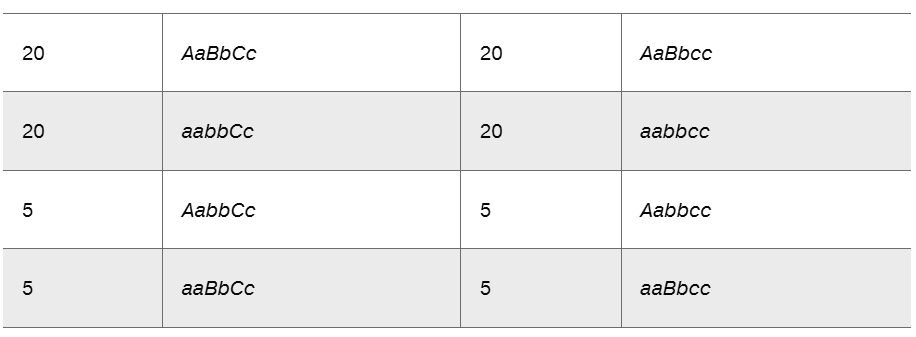
An organism of the genotype AaBbCc was testcrossed to a triply recessive organism (aabbcc). The genotypes of the progeny are presented in the following table.
If these three genes were all assorting independently, how many genotypic and phenotypic classes would result in the offspring, and in what proportion, assuming simple dominance and recessiveness in each gene pair?
In Drosophila, Dichaete (D) is a mutation on chromosome III with a dominant effect on wing shape. It is lethal when homozygous. The genes ebony body (e) and pink eye (p) are recessive mutations on chromosome III. Flies from a Dichaete stock were crossed to homozygous ebony, pink flies, and the F₁ progeny, with a Dichaete phenotype, were backcrossed to the ebony, pink homozygotes. Using the results of this backcross shown in the table.
Diagram this cross, showing the genotypes of the parents and offspring of both crosses.
In Drosophila, Dichaete (D) is a mutation on chromosome III with a dominant effect on wing shape. It is lethal when homozygous. The genes ebony body (e) and pink eye (p) are recessive mutations on chromosome III. Flies from a Dichaete stock were crossed to homozygous ebony, pink flies, and the F1 progeny, with a Dichaete phenotype, were backcrossed to the ebony, pink homozygotes. Using the results of this backcross shown in the table,
What is the sequence and interlocus distance between these three genes?
An organism of the genotype AaBbCc was testcrossed to a triply recessive organism (aabbcc). The genotypes of the progeny are presented in the following table.
What can you conclude from the actual data about the location of the three genes in relation to one another?