Drosophila may be monosomic for chromosome 4, yet remain fertile. Contrast the F₁ and F₂ results of the following crosses involving the recessive chromosome 4 trait, bent bristles:
monosomic IV, normal bristles x diploid, bent bristles.
Klug 10th Edition
Ch. 6 - Chromosome Mutations: Variation in Number and Arrangement
Problem 13
Verified step by step guidance
Drosophila may be monosomic for chromosome 4, yet remain fertile. Contrast the F₁ and F₂ results of the following crosses involving the recessive chromosome 4 trait, bent bristles:
monosomic IV, normal bristles x diploid, bent bristles.
Inversions are said to 'suppress crossing over.' Is this terminology technically correct? If not, restate the description accurately.
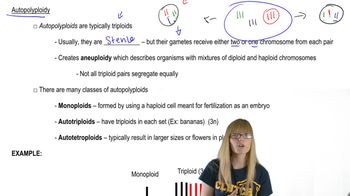
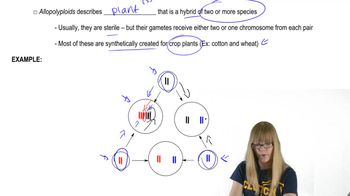
Certain varieties of chrysanthemums contain 18, 36, 54, 72, and 90 chromosomes; all are multiples of a basic set of nine chromosomes. How would you describe these varieties genetically? What feature do the karyotypes of each variety share? A variety with 27 chromosomes has been discovered, but it is sterile. Why?
Drosophila may be monosomic for chromosome 4, yet remain fertile. Contrast the F₁ and F₂ results of the following crosses involving the recessive chromosome 4 trait, bent bristles:
monosomic IV, bent bristles x diploid, normal bristles
Human adult hemoglobin is a tetramer containing two alpha (α) and two beta (β) polypeptide chains. The α gene cluster on chromosome 16 and the β gene cluster on chromosome 11 share amino acid similarities such that 61 of the amino acids of the α-globin polypeptide (141 amino acids long) are shared in identical sequence with the β-globin polypeptide (146 amino acids long). How might one explain the existence of two polypeptides with partially shared function and structure on two different chromosomes?